

She's Gotta Have Kicks: From The Margins to The Mainstream: Women's Role In Sneaker Culture
365 Kicks — Article share.google/CE3FXDXGtz9X...
03.11.2025 17:38
👍 0
🔁 0
💬 0
📌 0
She's Gotta Have Kicks: From The Margins to The Mainstream: Women's Role In Sneaker Culture
365 Kicks — Article share.google/CE3FXDXGtz9X...
It's important to take a look back at those that paved the way, as we could never forget the work that was done to carve space for women within sports. #JMC602
Just seeing a black woman talking about sports on a national television platform allowed black little girls to dream of a world of sports. And we've seen the outcome of that with the Jamele Hill’s and Cari Champion’s of the world, dominating on television screens in the past decade. #JMC602
This was an important conversation for me. Because it would remind me of Jayne Kennedy, the first black woman sports reporter on CBS’ The NFL Today in the 1970s, who did an amazing job paving the way forward for the women in sports media coming after her, especially black women. #JMC602
Her husband was a former Bears receiver, and I had I just mentioned her because, you know, she passed away fairly recently, and she was a real role model and really generous.” 2/2 #JMC602
“Yeah. I was not the first woman. There was a wonderful woman, by the name of Jeanie Morris, who was with the TV station. She was covering them in the 70s really? Well, on television... 1/2 #JMC602
Melissa Isaacson, veteran Chicago sports beat writer, joined our journalism masterclass with stories and advice from a storied career. At one point she spoke about the women that came before her. #JMC602
A 🧵
It was nice to see at I'm following a long tradition of women in sports media, making their way. 3/3 #JMC602
...started talking about the WNBA on the air, and then I pitched an idea to become their reporter for the radio station. And though my main job is still producer, I've managed to get my foot in the door of sports journalism by paying attention and being proactive. 2/3 #JMC602
This story resonated with me because I also became a reporter similarly. I became a radio producer and then decided I wanted to be more involved in the world of sports. I noticed that the only available beat was the WNBA, simply because we hadn't covered it at all. 1/3 #JMC602
Can you take this? And then how about if you take this? And then six months later they were like, you know, you've written too much. You were an independent contractor. You can't do this anymore.” 2/2 #JMC602
Isaacson states, “I started working for ESPN almost on my own. Like, I literally don't think I even asked anyone. I was like, I'm going to write you guys something. 1/2 #JMC602
Melissa Isaacson, veteran Chicago sports beat writer, joined our journalism masterclass with stories and advice from a storied career. At one point she spoke about how she began working at ESPN. #JMC602
A 🧵
These two instances of reporting show how important integrity is and the fine line that journalists have to walk between reporting the truth and remaining employed. #JMC602
In this case, a journalist has decided to fan the flames for profit, instead of investigating an exciting story about talent, popularity and an already existing league, trying to get its footing.#JMC602
Except in this book, Brennan paints other WNA players in a negative light, in an attempt to write a bestseller. Clark, for her part, refused an interview with Brennan, while the other WNBA players mentioned within the book, took exception to the way they were portrayed. #JMC602

This story brings to light the situation with Christine Brennan and her unauthorized Caitlin Clark biography, On Her Game. #JMC602
📷: Simon and Simon
In writing a book that dared to paint Michael Jordan in a light that was less than perfect, Smith's career was effectively sacrificed. Though the book sold well, he was unable to continue his beat in Chicago. #JMC602
And one of the reasons why it was such a big deal is because it had negatively portrayed Michael Jordan at a time when he was a god. And, and so clearly he couldn't cover the beat anymore, became clear at that time that, because he wrote this book, he would still be the Bigfoot NBA writer” #JMC602
Isaacson states, "[Sam Smith] just wrote a book called Jordan Rules, which, if you've never seen it, was one of the really first kind of its time, big sports books. it made it. It sold a ton of books. I'm not sure if it was a New York Times bestseller, but it did very well. 1/2 #JMC602

She spoke on many moments over career, but I’d like to focus on Chicago journalist Sam Smith and the book Jordan Rules. #JMC602
📷: Google
Having the chance to hear Melissa Isaacson speak about her experience as a beat writer in Chicago during the 80s and 90s brightest sports moments was a personal and professional treat. #JMC602
A 🧵
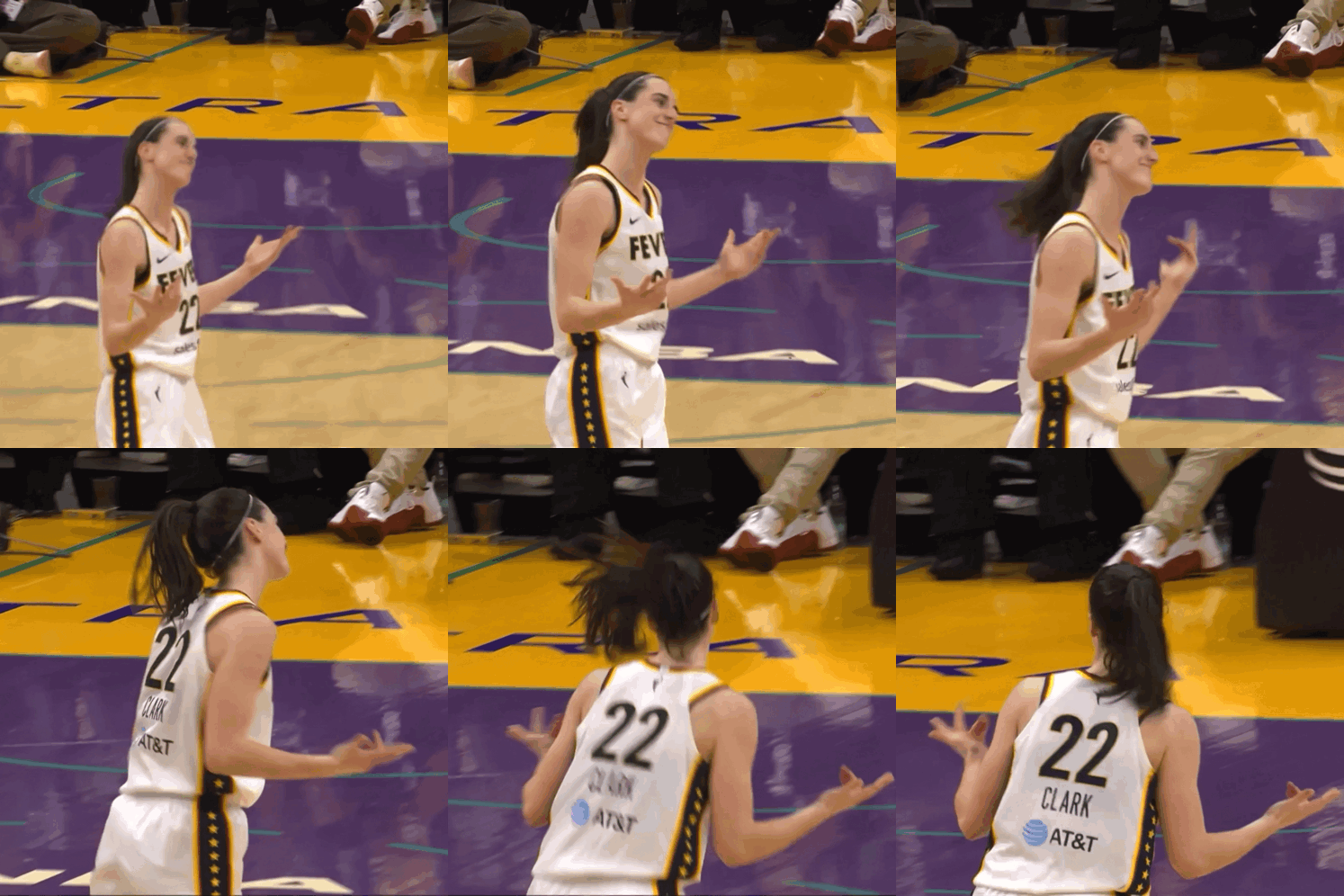
If any other player missed 56% of the season, shooting 29.5% from 3, while leading the league in turnovers, they’d be lucky to be a reserve on the team, let alone a captain. #JMC602
An All-Star selection is not about off-court impact, TV ratings, or chartered flights. It’s about individual achievements on the court. #JMC602
He did not, however, mention an on-court basketball reason as to why Clark should have been voted number one across the board. #JMC602

Vitale lists several changes within the W that were either in progress or still in progress and attributes those to Clark, concluding, “No doubt she is THE BEST thing to happen to the WNBA.” #JMC602

Legendary basketball analyst Dick Vitale expressed his outrage over the media and player results, accusing them of jealousy and mistreatment. He implies that not voting for her as the top overall player makes them ungrateful. #JMC602

In the seven games played without Clark, she managed to pass her as the team’s leading scorer and helped lead the Fever to a Commissioner's Cup win. #JMC602


Even in the Yahoo! article, the led is, “Clark finished behind her teammate in the player voting.” The teammate in question is guard Kelsey Mitchell, who’s had more on her plate with Clark’s injury absences. #JMC602

So why is the voting so controversial? #JMC602