

Poppy is “helping” me read this paper today
13.10.2025 19:08
👍 1
🔁 0
💬 0
📌 0
Poppy is “helping” me read this paper today
A big thank you to The University of Arizona's Pain and Addiction Center for giving me pilot funds to do this study!
Plus a big shout out to my wonderful mentor @doctor-bob.bsky.social, plus the brilliant second author Larissa Oliveira, and the excellent undergrads also listed.

To conclude... have pain? As Estonia's Eurovision entry would say "No stresso" your working memory may be OK-o!
We did have some limitations - our chronic pain group were highly functioning undergraduates who had relatively low levels of pain severity and interference, so pain may not have been sufficient to cause deficits.
But this group is certainly worthy of study, particularly for looking at resilience.
This adds to the growing literature suggesting that pain itself may not be the cause of deficits in working memory.
BUT the pain of null results...
Acute pain had no effect on response time or accuracy in younger or older folks
Chronic pain had no effect on response time or accuracy
Suggesting a lack of pain effect on working memory in the Sternberg Task

🙂We saw pain reported at levels consistent with other papers
😊That lovely Sternberg effect
😀As well as decreased accuracy in older people, suggesting impaired working memory
I was as excited as Estonia's entry in Eurovision was excited about an Espresso Macchiato

We thought the ideal task to test both of these hypotheses was the Sternberg Task.
⭐5 levels of difficulty
⭐Response time increases with items in working memory (see fig - look at that lovely line!)
⭐ ideal for testing both limited slots in working memory and arousal hypotheses ⭐

High levels of pain + a difficult task = not enough slots in working memory to do the task well
But pain is also arousing and performance of cognitive tasks depends on optimum arousal levels - as seen in this gif. Could pain be taking us over optimum arousal levels?
Pain is generally thought to cause deficits in working memory - information that you can recall and manipulate over a short time period.
The prevailing hypothesis is that this is through pain taking up slots in working memory - which is limited to 7(ish!) slots
Is the pain of null data taking up slots in your working memory? Or shifting you over optimum arousal on the Yerkes Dodson curve?
Not for me! I've externalized it to this lovely preprint!
Plus, read on for why it might not be the pain that causes deficits in your working memory... 🧵
Poppy, Stella and Noelle 100% agree with this writeup

When is a "pathogenic" variant in a classic pain gene (NaV1.7) not pathogenic? When its carried by many thousands of people and has no evidence of a pain phenotype or analgesic prescriptions... We need to reconsider how we assign pathogenicity to these variants.
www.medrxiv.org/content/10.1...

Interested in dopamine? Have fMRI data? We’ve identified a temporal BOLD feature that carries rich information about dopamine physiology. This measure, obtainable from resting-state and task fMRI, opens new ways to indirectly probe dopamine’s role in cognition and disease. 1/n tinyurl.com/bddyz67b

Excited to share our latest publication, out now in @ScienceAdvances: “Thermosensory predictive coding underpins an illusion of pain.” www.science.org/doi/10.1126/.... Read the full thread for details!

Why do we remember so many details of our experiences even when it is unclear if we will actually ever need them?
In a new preprint, @marcelomattar.bsky.social and I asked whether this property is adaptive, because what will be relevant in the future often (usually?!) isn’t apparent.
***New paper from our lab*** By Jennika Veinot
Low working memory underpins the association between aberrant functional properties of pain modulation circuitry and chronic back pain severity.
Journal of PAIN, 2025
www.sciencedirect.com/science/arti...
#pain #neuroscience #cognition

Can you blind taste and guess Sauvignon Blanc from Riesling? If so, congrats—they’re pretty different! But just know… rats can too. 🐀🍾 h/t @cprofaci.bsky.social
link.springer.com/article/10.1...

ala Great British Baking show, academic sitting on floor staring into oven (parallel to email from editor)
Guilty, as charged
#AcademicSky
#AcademicWriting
This work was completed with lots of wonderful people, particularly the PI, Dr. Horizon Task himself, @doctor-bob.bsky.social as well as all the technicians and undergrads in our big author list.
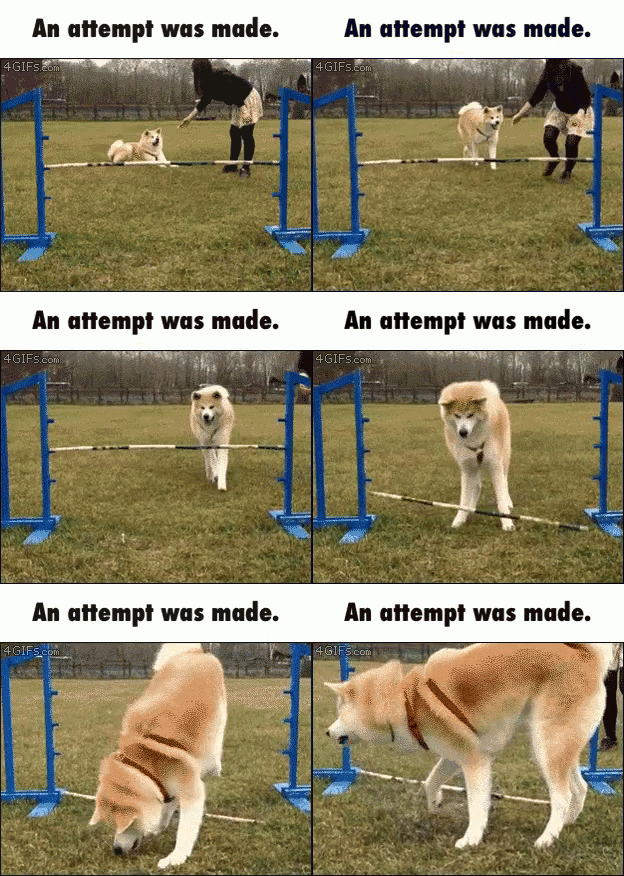
But this comes at the detriment of less random exploration. Which may be why it's harder to teach an old dog new tricks
We found that older adults have a lower signal to noise ratio, which could result in more errors.
BUT older adults also had a higher threshold for decision making.
Potentially this is a healthy aging adaption which helps to reduce errors, as older adults outperformed younger adults.

Older adults use less random exploration, so how does this happen?
We focus on the drift diffusion model, where evidence for a decision is noisily accumulated over time, until it passes the threshold for one option or the other.

A good way to look at this is sending our participants to a virtual Vegas, playing a choice of two slot machines in the Horizon Task.
In which the amount of info they receive about both slot machines varies as well as how long they have to use that info - so how advantageous it is to explore
There are two strategies to exploring:
* Directed exploration is an explicit bias towards choosing more informative options.
* Random exploration- a ‘noisy’ choice selection, where choices are less obviously tied to the value of options.
In contrast, exploiting and staying in academia could lead to you publishing exciting preprints, but leave you forever wondering if you could have done well on the Great British Bake Off.
The balance between exploring and exploiting shifts towards less exploration in older people
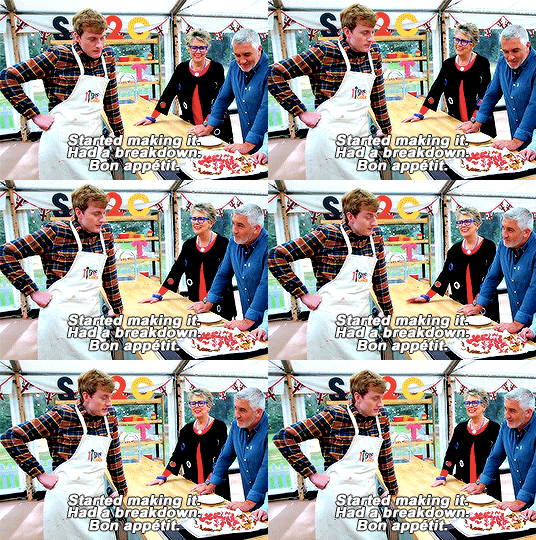
We are faced with many 'explore-exploit' decisions throughout our lives. For instance, the eternal postdoc conundrum, do you continue you exploit what you know and continue in academia or explore a new career as a baker?
Exploring a career as a baker could lead to a life making beautiful cakes or..
Are you feeling stuck in your ways? Less excited about exploring anything new? You may be aging!
Read on for insight into why your decision making is changing.
Maybe its the same for emeritus professors?!