NEW: Vida Maralani, Camille Portier, Berkay Özcan, "Early Childhood Investments and Women’s Work Outcomes across the Life Course" sociologicalscience.com/articles-v13...
24.02.2026 17:45
👍 15
🔁 5
💬 0
📌 1
NEW: Vida Maralani, Camille Portier, Berkay Özcan, "Early Childhood Investments and Women’s Work Outcomes across the Life Course" sociologicalscience.com/articles-v13...
📣 Social Network Analysis people - there is still time to submit an abstract for our special issue on Social Network Analysis. Deadline 1st of March.
journals.sagepub.com/topic/collec...


📢 In this Social Forces article, I introduce occupational elitism as a novel measure of social closure: the share of upper-class background workers within an occupation.
Its consequences for earnings stratification can be examined using a social closure theory lens.
🔓 doi.org/10.1093/sf/s...

Red Valentine-style graphic with large white text Our love passes peer review Valentine; lower left has the labels to: and from: with blank space; right side shows an illustration of a hand holding a magnifying glass over a paper with black lines and a green approval stamp; bottom right includes ISR’s logo.

Purple Valentine-style graphic with large white text Our connection is well beyond the margin of error Valentine; lower left has the labels to: and from: with blank space; right side shows hands using a calculator with a screen displaying z x (s divided by square root of n) and two small red hearts floating above; bottom center includes ISR’s logo.

Brown Valentine-style graphic with large white text You are the qualitative insight to my quantitative heart; lower left has the labels to: and from: with blank space; lower right shows two overlapping hearts, one white with a light gray grid pattern and one solid pink; bottom right includes ISR’s logo.

Purple Valentine-style graphic with large white text I would share my dataset with you; lower left has the labels to: and from: with blank space; center shows two hands, one light-skinned and one dark-skinned, holding a note that reads f(x)= followed by a red heart symbol; bottom right includes ISR’s logo.
If you haven't been asked yet, here is your sign to be our ISR Valentine ❤️
Gillian Diggins (Communities Analyis Division of the Scottish Government) will discuss - 'Measuring levels of persistent poverty in Scotland' using UKHLS data
Louise Rowllings (University of Edinburgh Business School) will share UKHLS analysis from her PhD research
📣 The next Scottish UKHLS (@usociety.bsky.social) User Group Meeting will be on the 24th of April 1500-1630 Online @uoe-sps.bsky.social
To receive the meeting invite sign up to the mailing list here: edin.ac/48nQsc2

Call for #SNA papers by @methodinnovations.bsky.social
journals.sagepub.com/topic/collec....

Understanding Society Wave 15 is out today!
The latest wave of data can be accessed via the @ukdataservice.bsky.social. New content includes questions on pregnancies, guardians, and environmental identity.
www.understandingsociety.ac.uk/news/2025/12...
In our research on socioeconomic background in academia, we ran a survey. Over 2,000 faculty members responded (thanks if you were one!)
Social & cultural capital showed up time and again as key issues.
A few findings you might be interested in...🧵

Front cover of The Division of Rationalized Labor. The cover includes four pictures: pen and paper, microscope, factory tower, police badge. Modern-looking yellow lines and graphs are superimposed.
My new book, The Division of Rationalized Labor, is now shipping! A brief summary of the argument to follow…
👇Our Generative AI special issue call is open until the 9th of January. We are open to all types of articles which relate to the intersection of Generative AI and Social Science Research Methods.
Please get in touch if you wish to discuss your article!

Is childhood exposure to local wealth inequality associated with upward income mobility achieved in adulthood? Yes! Check out my new paper, just published in @natureportfolio.nature.com here: doi.org/10.1038/s414... #EconSky #Sociology #Demography
📣Do you have experience of using Generative AI in your social science research? Or critical thoughts about the use of Generative AI? Consider contributing an article to our special issue!
📢 New in @sfjournal.bsky.social: We study how parental #education shapes children’s #cognitive development. Accounting for selective parenthood & grandparent & early parent characteristics, we find education largely reflects broader #intergenerational advantages. academic.oup.com/sf/advance-a...

I wrote about @hermwerf.bsky.social 's excellent ASR article last year on education expansion and intergenerational mobility.
Hope you find it useful!
asocial.substack.com/p/inequality...

📣 New publication in Research in Social Stratification and Mobility!
🔎 Do mothers’ occupation-specific skills shape children’s development?
✅ Yes! When mothers move into jobs with higher skill demands, their kids show stronger skills.
Open access here 👉 www.sciencedirect.com/science/arti...

📣 The Call for Papers for the British Journal of Sociology 2026 Conference is open!
Following the success of our inaugural conference in 2024, we are delighted to announce its return on 23 and 24 April 2026 at LSE.
📆 Submit your paper by 20 October 2025 ➡️ buff.ly/TdmBcur
Reviewing our questions on ethnicity and immigration.
Let us know your views on this important part of the @usociety.bsky.social survey.
www.understandingsociety.ac.uk/news/2025/06...

New paper in Research in Social Stratification and Mobility! I track long-term trends in educational assortative mating in 🇧🇷. After decades of decline, homogamy rose in the 2000s, due to a balance shift: more fluidity at lower edu levels vs. stronger homogamy at the top.
Check it out (open access):

View of Parliament and surrounding buildings across the Thames
🎉New on the Data Impact blog🎉
Jay Dominy, Public Affairs Manager at UCL and CLOSER, introduces CLOSER’s new monthly Policy Surgeries and encourages researchers interested in informing policy to sign-up.
blog.ukdataservice.ac.uk/closer-polic...
Professor Debora Price @gerontologyuk.bsky.social
recently reflected on recent international threats to data infrastructure, and why we must protect trusted data services as essential public institutions, on the Data Impact blog
blog.ukdataservice.ac.uk/why-data-pre...
💥Today, 3 years after I graduated from my research master, my (revamped) master thesis got published at @ssreditorial.bsky.social under the name "Who do they think you are? Inconsistencies in self- and proxy-reports of education within families". Check it out here: doi.org/10.1016/j.ss... (OA)

💬 "Ultimately, lots of working-class people simply cannot afford to work for no or little pay. It’s a luxury only some can afford."
Our alum, Bethany, draws on her experience of working for free to discuss the need for change on the usage of unpaid labour ⬇️
www.suttontrust.com/news-opinion...

The next meeting of the Scottish UKHLS User Group will be online on Friday 15th August from 1500-1630
This time there will be talks from Laurence Rowley-Abel @uoe-sps.bsky.social and Mhairi Webster @yunuscentregcu.bsky.social
Sign up here: www.eventbrite.co.uk/e/scotttish-...
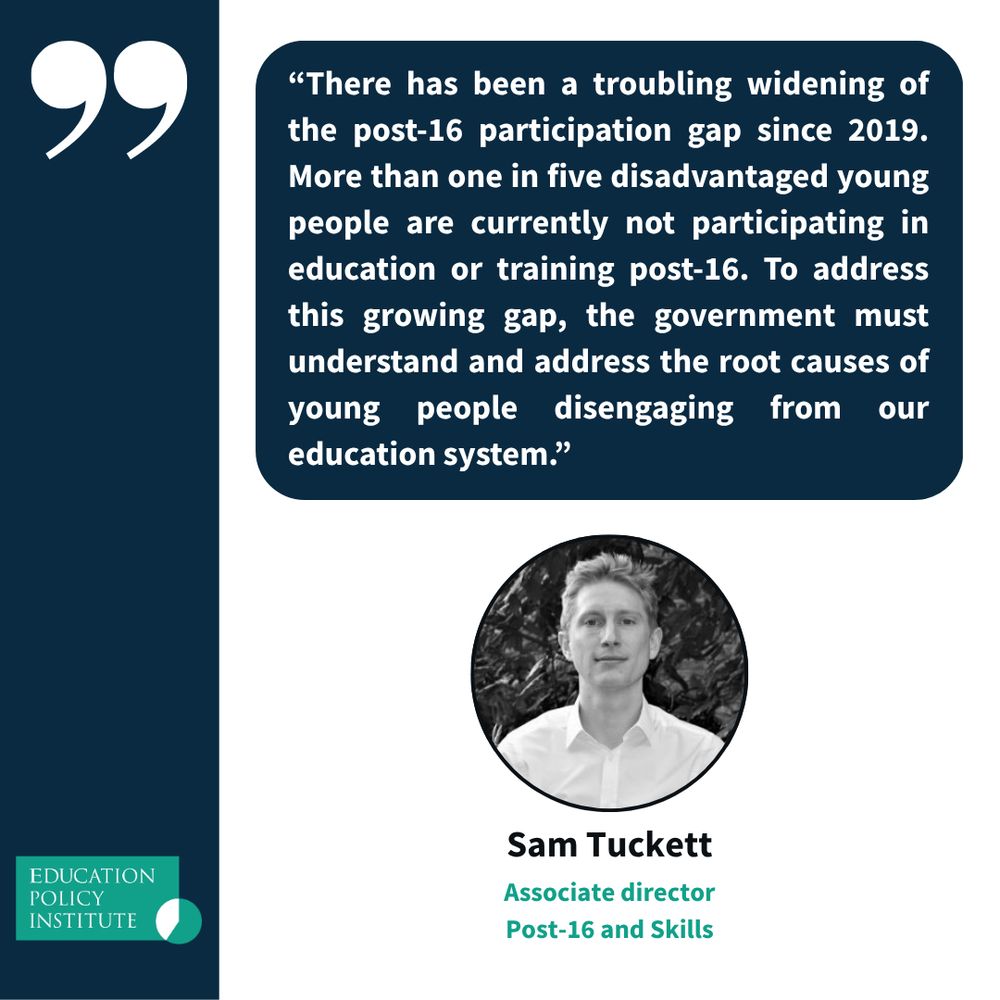
Our Annual Report reveals a troubling trend: fewer disadvantaged young people are participating post-16 than at any point since 2019.
More than 1 in 5 disadvantaged 16-year-olds are now out of education or training.
It’s time to identify — and act on — the root causes of this sharp decline.

Theoretical models have been developed to understand how social class influences individual thoughts, feelings and behaviours. However, the validity of these models is threatened by the prevailing use of small, non-diverse samples and flexible measurement practices. We preregistered replications of 35 key hypotheses from 17 correlational and 5 experimental studies, and collected large, quota-based or probability samples from the USA, France, Switzerland and India (Ntotal = 33,536). Our analysis yielded three central findings: (1) ~50% of the effects were successfully replicated; (2) conclusions were consistent across different operationalizations of social class, although objective indicators yielded smaller estimates (for example, income and education); and (3) half of the effects were moderated—mostly strengthened—by social class identification, system-justification beliefs or local income inequality. Overall, hypotheses based on differences between social class contexts in terms of constraints, uncertainty and status were well supported. However, hypotheses based on models positing social class differences in psychological orientations towards ‘the self’ versus ‘others and the environment’ received less support. We conclude that these models need to be reassessed as individuals from higher social classes seem more oriented towards both themselves and others. The Stage 1 protocol for this Registered Report was accepted in principle on 29 October 2021. The protocol, as accepted by the journal, can be found at https://doi.org/10.17605/OSF.IO/B6Y8R.
Registered report of 35 social class hypotheses (N = 33,536) finds around 50% are supported.
New work by @anatoliab.bsky.social, Nicolas Sommet, and @frederiqueautin.bsky.social
Open Access: doi.org/10.1038/s415...

New study finds that politically diverse social networks, even casual acquaintances, reduce partisan hostility by exposing people to others with opposing views, correcting stereotypes, and fostering understanding.
sociologicalscience.com/articles-v12...

❗ Important work from @edupolicyinst.bsky.social highlighting the attainment gap between disadvantaged children & their peers.
Their annual report shows that the gap in attainment between 5 year olds from low income families & their peers has grown since 2019.
www.theguardian.com/education/20...

🚂 | NEW REPORT: Britain’s transport system is failing people on low incomes — locking them out of work, health, and opportunity. Our new report sets out how to fix it 👇
www.ippr.org/articles/the...