
Check out our new paper! We evaluate what we know (and don't know) about the link between memory consolidation during sleep and next-day learning 👇
19.11.2025 18:42
👍 21
🔁 9
💬 0
📌 0
Check out our new paper! We evaluate what we know (and don't know) about the link between memory consolidation during sleep and next-day learning 👇
How well do classifiers trained on visual activity actually transfer to non-visual reactivation?
#Decoding studies often rely on training in one (visual) condition and applying it to another (e.g. rest-reactivation). However: How well does this work? Show us what makes it work and win up to 1000$!
Come join our group!
Excited to share our newly published paper! 👇 Massive thanks to @harrington-mo.bsky.social @sacairney.bsky.social @mggaskell.bsky.social
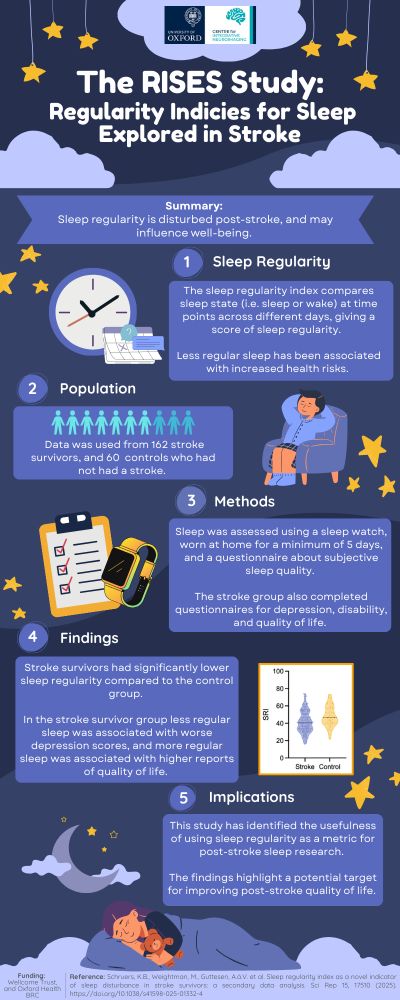
An infographic summarising the methods and findings of the RISES Study. Images of stars, the moon, and people sleeping with text as follows. Summary: Sleep regularity is disturbed post-stroke, and may influence well-being. Sleep regularity: The sleep regularity index compares sleep state (i.e. sleep or wake) at time points across different days, giving a score of sleep regularity. Less regular sleep has been associated with increased health risks. Population: Data was used from 162 stroke survivors, and 60 controls who had not had a stroke. Methods: Sleep was assessed using a sleep watch, worn at home for a minimum of 5 days, and a questionnaire about subjective sleep quality. The stroke group also completed questionnaires for depression, disability, and quality of life. Findings: Stroke survivors had significantly lower sleep regularity compared to the control group. In the stroke survivor group less regular sleep was associated with worse depression scores, and more regular sleep was associated with higher reports of quality of life. Implications: This study has identified the usefulness of using sleep regularity as a metric for post-stroke sleep research. The findings highlight a potential target for improving post-stroke quality of life. Funding: Funding: Wellcome Trust, and Oxford Health BRC. Reference: Reference: Schruers, K.B., Weightman, M., Guttesen, A.á.V. et al. Sleep regularity index as a novel indicator of sleep disturbance in stroke survivors: a secondary data analysis. Sci Rep 15, 17510 (2025). https://doi.org/10.1038/s41598-025-01332-4
📣 New paper alert! 📣
🔎 The RISES Study looked at the sleep regularity index in stroke survivors compared to people who haven't had a stroke.
🔗 See a summary of our findings in our infographic below, and find the full paper here: rdcu.be/emZ09
@oxcin.bsky.social @ndcnoxford.bsky.social
Check out this exciting new paper on sleep regularity after stroke led by the brilliant @katschruers.bsky.social!
join us at @oxexppsy.bsky.social | @ox.ac.uk!
Preprint alert! 🚨
1/ How does deep sleep reshape our memories? Our new study shows that slow-wave sleep (SWS) reorganises episodic memory networks, shifting recall from the parietal cortex to the anterior temporal lobe (ATL). With Polina Perzich and @bstaresina.bsky.social . A thread below👇

Why do we suffer from more intrusive thoughts when we're sleep deprived? Find out in this SciAm article on our latest work by @rachelnuwer.bsky.social, featuring @zarabergstrom.bsky.social and @marwimber.bsky.social www.scientificamerican.com/article/bad-...

From Bernhard Staresina: "Sleep spindles can be experimentally moved across the brain! In our new study, @thom_jude shows how spindles during sleep track cortical hot spots created during wake with transcranial electrical stimulation." www.biorxiv.org/content/10.1...

Ecstatic to receive an ERC Consolidator Grant to lead “SLEEPAWAY: Forgetting unwanted memories in sleep” @yorkpsychology.bsky.social Stay tuned for job ads in 2025! #ERCCoG erc.europa.eu/news-events/...