

If Alien Signals Reached Earth, Why Haven't We Seen Them?
astrobiology.com/2026/02/if-a... #astrobiology #SETI #technosignature
17.02.2026 18:11
👍 9
🔁 2
💬 0
📌 0
If Alien Signals Reached Earth, Why Haven't We Seen Them?
astrobiology.com/2026/02/if-a... #astrobiology #SETI #technosignature

Excited to share preprint of my new research: The Interplanetary Habitable Zone - habitability for space-faring species. A maths framework & agent-based simulation approach: arxiv.org/abs/2602.13404
You know it's a good science day when you get to write "boundedly rational utility maximizers" in an astrobiology research paper
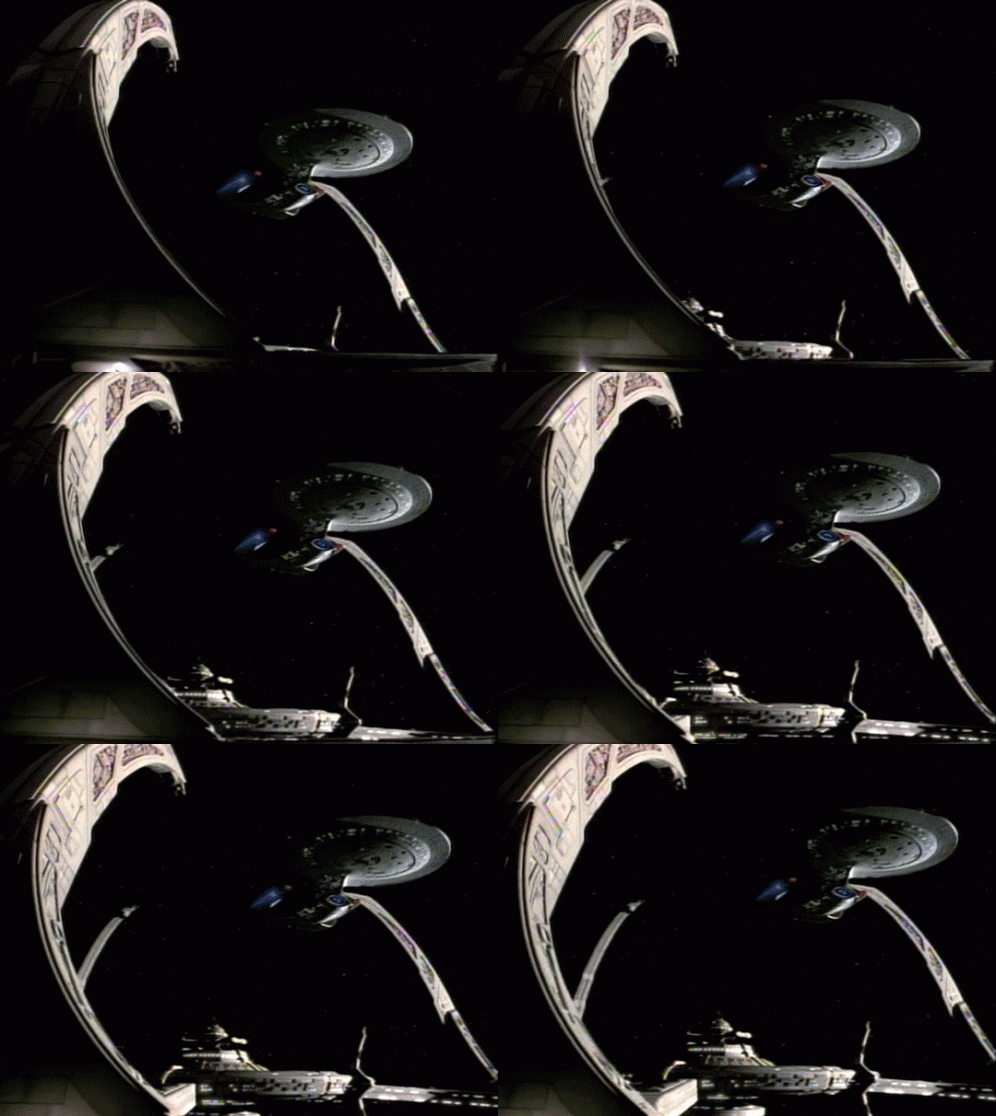
Why might our future in space look more like living on Deep Space Nine than colonizing other planets? Dr. @calebscharf.bsky.social explains on this recent episode of Strange New Worlds: A Science & Star Trek Podcast! soundcloud.com/strange-new-...

New planet just dropped and it
1) is almost exactly Earth-sized
2) has a year that's almost exactly 1 Earth year.
3) orbits a star that is not a 💢temperamental little shit M-dwarf 💢but is instead a 🧡 good orange boi 🧡
Me for @science.org based on results presented at #RockyWorlds4: 🔭🧪

Yup
If you want to know what it's like when two scientists who really enjoy each other's company sit down for a conversation about science, space, and life in the universe, well here's the answer:
I can attest that this is a terrific book!

@nautil.us has this excellent series of "greatest revelations" from authors and others. I got to have my turn in talking about The Giant Leap and the things it revealed to me along the way... nautil.us/space-explor...

Thrilled to see a great review of The Giant Leap over at the
@wsj.com ! “A scintillating tour of mankind’s explorations in space so far.” 😀 www.wsj.com/arts-culture...
For a moment this phrasing gave me a nice vision of pigs sitting around discussing ancestry…
San Diego?

New interview about The Giant Leap is now available - many thanks to Smithsonian Associates and Paul Vogelzang for a terrific conversation! podcasts.apple.com/us/podcast/t...
This is just incredible and lovely! Life in the abyss.

Photo of a turtle frog. Attribution: By Stephen Zozaya - Vertucci S, Pepper M, Edwards DL, Roberts JD, Mitchell N, Keogh JS (2017) Evolutionary and natural history of the turtle frog, Myobatrachus gouldii, a bizarre myobatrachid frog in the southwestern Australian biodiversity hotspot. PLoS ONE 12(3): e0173348.doi:10.1371/journal.pone.0173348.g001., CC BY 2.5, https://commons.wikimedia.org/w/index.php?curid=58023200
I haven’t stopped thinking about this frog since learning about it a few days ago, so now this knowledge is your problem too.
Meet the turtle frog (Myobatrachus gouldii) – a round burrow gremlin from Australia. It gets its name from looking like a turtle that lost its shell.
📸 Stephen Zozaya
Thanks @brianclegg.bsky.social for such a thoughtful review! Delighted that the book was of interest!

It's Friday, the holidays are upon us, what better time to read a book about the amazing enterprise of space exploration, and what it means for life on Earth!
Another conversation about my new book The Giant Leap (@BasicBooks) is now live! Space exploration is such a rich topic and it stirs so many viewpoints, it's very fascinating. convergingdialogues.substack.com/p/456-the-fu...

New conversation about my book The Giant Leap and quite a lot more - life in the universe, data, and the future of space w. Brad Carr: www.youtube.com/watch?v=g5Kd...

This image shows three-dimensional, millimeter-thick, and cell-embeddable semiconducting hydrogel fibers.
This image shows 3D, millimeter-thick, and cell-embeddable semiconducting hydrogel fibers.
These fibers can be used to construct interwoven living transistors that mimic real neuronal connections in the brain, redefining the boundary between technology and life. Learn more: https://scim.ag/4rqTOCj
(and I recognize the irony in posting this here where it will not be seen...🤣)
I am puzzled by Bluesky: posts here seem to have a really hard time being seen by...well, anyone. Maybe I'm just losing my touch...
In my new book I explore the complex history of space exploration and its staggering impacts on human life and all life on Earth - for better or worse. To see what the future might bring we have to place space into context, as fundamental change to evolutionary possibilities.
A must listen…!

ICYMI had a terrific time talking with @adamfrank4.bsky.social for this @bigthink.com interview about The Giant Leap (Basic Books) and the implications of space exploration for the near and far future of life on Earth. bigthink.com/13-8/the-nex...

Interstellar comet ATLAS seen early this morning as a thin crescent moon passed immediately next to it. Still was able to capture three separate jets of ionic tail, and an anti tail? Or the dust tail? The comet was also passing by the galaxy NGC4691, which really gave the impression of the object being from another world.
Marvelous new image of interstellar Comet 3I/ATLAS, taken by photographer Satoru Murata before dawn this morning.
On the right you can also see galaxy NGC 4691. There should be a lot more pictures coming in soon. 🧪🔭
www.facebook.com/groups/22700...
Great news!

Fabulous! You might be interested in this too, some adjacent musings on latent representations and space science arxiv.org/abs/2507.11400

ICYMI: Last week, @calebscharf.bsky.social asked us to imagine space exploration as life’s next "Giant Leap" during our most recent #NeighborhoodLecture.
We pulled out 5 of the most mind-blowing ideas and posted the full recording here.👇🤯
carnegiescience.edu/five-ways-ca...

New video! My full presentation about The Giant Leap to a live audience at @carnegiescience.bsky.social is now online! We grappled with science, philosophy, and the meaning of life! www.youtube.com/watch?v=cG1V...