Next week on Fragile Nucleosome:
🧬 Pavan Choppakatla from the Levine lab will share his work on long-distance enhancer-promoter search
🧬 @moorejille.bsky.social will tell us about millions of enhancers in the registry of candidate CREs
Register here and join us!: us06web.zoom.us/webinar/regi...
18.02.2026 18:04
👍 8
🔁 4
💬 0
📌 1
These data display regions identified by biochemical signatures predicted to regulate gene expression as promoters, enhancers, or other regulatory elements.
We would like to thank Zhiping Weng, and Jill Moore for their work in producing and displaying these data.
15.01.2026 20:00
👍 1
🔁 1
💬 0
📌 0

UMass Chan scientists annotate largest map yet of human genome’s regulatory switches
A UMass Chan-led research team has nearly tripled the known number of potential regulatory elements in the genome to 2.37 million.
A UMass Chan-led research team has nearly tripled the known number of potential regulatory elements in the genome to 2.37 million. Read about the paper, published in @nature.com, on the new registry: direc.to/oouM
#genome #epigenetics #CRE @moorejille.bsky.social @zhipingweng.bsky.social
15.01.2026 13:27
👍 4
🔁 2
💬 0
📌 0

a red and blue background with the words that 's all folks on it
ALT: a red and blue background with the words that 's all folks on it
Thanks for following along.
If you’re interested in this kind of work — regulatory genomics, functional data integration, and building shared resources — don’t hesitate to reach out. We’re always open to new ideas and collaborations. 11/11
08.01.2026 02:03
👍 3
🔁 0
💬 0
📌 0
This work was a true team effort!
Huge thanks to the many experimentalists, analysts, software engineers, web developers, NIH leaders and ENCODE consortium members who made this work possible — everyone played a role in getting this across the goal line. 10/11
08.01.2026 02:03
👍 1
🔁 0
💬 1
📌 0

To make the Registry easy to use, it’s all accessible through screen.wenglab.org, which has undergone a complete redesign to improve the user experience.
You can explore individual genes, cCREs, variants, and phenotypes interactively, or download the full Registry for large-scale analyses. 9/11
08.01.2026 02:03
👍 1
🔁 0
💬 1
📌 0

a picture of gollum with the words " my dataaaa " below it
ALT: a picture of gollum with the words " my dataaaa " below it
Beyond prioritization, the Registry is also designed to integrate with your own data!
You can use cCREs to anchor study-specific assays — including DNA methylation, single-cell or single-nucleus ATAC-seq, chromatin states — and as input features for predictive and machine learning models. 8/11
08.01.2026 02:03
👍 3
🔁 0
💬 1
📌 0

You can do a lot with the new Registry of cCREs — including gene and variant prioritization.
Using the Registry, we identified KLF1 as a likely causal gene for red blood cell traits, supported by regulatory annotations rather than simple proximity to reported variants. 7/11
08.01.2026 02:03
👍 0
🔁 0
💬 1
📌 0

We also found that some cCREs aren’t yet active — they’re just waiting.
We identified sets of dynamic enhancers characterized by MAFF/MAFK binding at inaccessible chromatin, which can become active in specific cell states under particular conditions. 6/11
08.01.2026 02:03
👍 2
🔁 0
💬 1
📌 0

But silencers are not all the same.
The silencers we identified show distinct features compared to those from other studies, suggesting potential diversity in silencer subclasses and mechanisms. This diversity explains why different silencer datasets often show limited overlap. 5/11
08.01.2026 02:03
👍 1
🔁 0
💬 1
📌 0

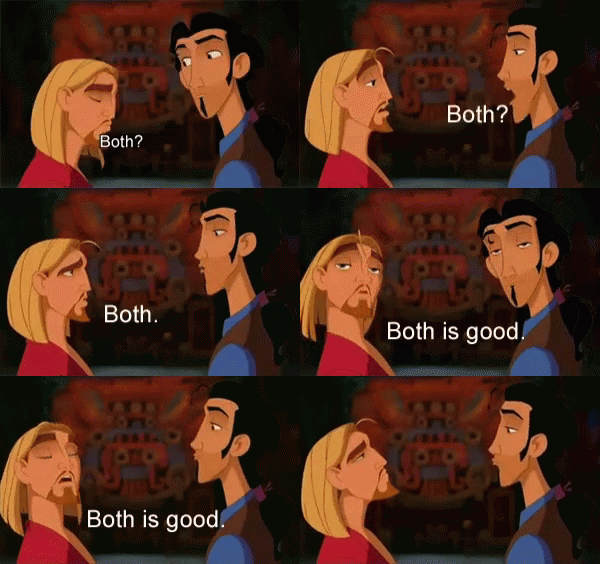
a man and a woman are looking at each other and the man is asking " both "
ALT: a man and a woman are looking at each other and the man is asking " both "
Functional data also enables us to identify silencers — cCREs that repress gene expression.
In some cases, the same cCRE can act as an enhancer in one cellular context and a silencer in another. 4/11
08.01.2026 02:03
👍 3
🔁 0
💬 1
📌 0

A larger Registry lets us do more than catalog elements —
it lets us study how sequence relates to function.
Some cCREs show modest activity on their own, but specific combinations have stronger-than-expected functional effects, revealing non-additive, combinatorial regulation. 3/11
08.01.2026 02:03
👍 2
🔁 0
💬 1
📌 0

a man wearing a shirt that says yes is smiling
ALT: a man wearing a shirt that says yes is smiling
This new Registry has everything:
• 2 million+ human & ~1 million mouse cCREs
• data from 1,000+ samples
• functional testing for >90% of human cCREs
• new cCRE classes (including silencers!)
• more cCRE–gene links
If you study gene regulation, this is the place to be. 2/11
08.01.2026 02:03
👍 1
🔁 0
💬 1
📌 0

a man wearing a plaid shirt and a purple hat is saying here we go .
ALT: a man wearing a plaid shirt and a purple hat is saying here we go .
Our paper on the Expanded Registry of candidate cis-Regulatory Elements (cCREs) is out 🎉
www.nature.com/articles/s41...
To celebrate, here’s a "meme-torial" walkthrough of the science.
Let’s get started 🧵 1/11
08.01.2026 02:03
👍 26
🔁 9
💬 1
📌 3

An expanded registry of candidate cis-regulatory elements - Nature
The existing ENCODE registry of candidate human and mouse cis-regulatory elements is expanded with the addition of new ENCODE data, integrating new functional data as well as new cell and tissue types...
Our paper on the newest version of the Registry of candidate cis-Regulatory Elements (cCREs) is out 🧬
Huge thanks to the many collaborators, experimentalists, analysts and software developers who made this work possible — truly a team effort!
A "meme-torial" of the science is coming soon 👀
07.01.2026 18:47
👍 56
🔁 31
💬 1
📌 2

Going to #ASHG25? Don’t miss our FREE interactive workshop on Investigating Non-Coding Regions with SCREEN and Factorbook. Wed Oct 15 @ 11:45 am, Room 104C (level 1)
🧬 Lunch included! 🧬
14.10.2025 14:03
👍 2
🔁 1
💬 1
📌 0
Excited that we will be co-leading the DAC with @ZhipingWeng (fearless leader) @MooreJillE & @thabangh for the new Multiomics for heath and disease consortium.
www.nih.gov/news-events/...
13.09.2023 04:18
👍 19
🔁 2
💬 2
📌 0