
Know someone who might be interested? Please share!
roche.wd3.myworkdayjobs.com/ROG-A2O-GENE...
22.01.2026 22:25
👍 0
🔁 0
💬 0
📌 0
Know someone who might be interested? Please share!
roche.wd3.myworkdayjobs.com/ROG-A2O-GENE...
I'm hiring a summer intern!
Pursuing a PhD and interested in industry experience?
Apply at the link below by Jan 26 to spend 12 weeks onsite at South San Francisco with Genentech's Discovery Oncology department in May-July 2026 pursuing novel therapies targeting disordered protein regions.
One point for McKnight but a new point for Brangwynne
www.ms-fund.keio.ac.jp/en/prize/
Just two scientists building our empires with style 💅🏼🙌🏼
And check out the other winners here 🎉
www.ascb.org/society-news...

Chuffed to be recognized with an Early Career Award for work on the chromatin-nucleated phase separation of BRD4. ✨ Give it a read!
www.molbiolcell.org/doi/full/10....
Shout-out @drjorine.bsky.social @brangwynnelab.bsky.social
And huge thank you @ascbiology.bsky.social
Thanks Jase! It's a whirlwind so far but I'm psyched to get started. Let's catch up!
It's so great!
First, organize and label. Then, science.

Getting Strom Lab set up!


First day at my new job!
I'm a Lab Head, Principal Scientist in Discovery Oncology at Genentech.
I'll be searching for new targets to develop cancer treatments.
2nd photo is my newest friend on campus, decoy-ote.
@genentech.bsky.social
The latest in my favorite love triangle:
Chromatin <-(💜)-> Condensates <-(💚)-> Mechanics

Cancelling grants that were already competitively won and awarded is the waste and abuse.
www.nytimes.com/2025/07/10/u...
Huge thanks to my family, mentors, and funders for making this path possible — and to Genentech for the leap of faith. Can’t wait to get started next month!
I'm thrilled to announce my next career step-- I’m joining Genentech as a Principal Scientist & Lab Head in Discovery Oncology!
I’ll be hunting new ways to target cancers using my background in disordered nuclear proteins.
Yes drew this sketch, love an excuse to spend a few mins in Illustrator :)
Re bulk chromatin it's hard to tell in vivo since we can't see H3K9me. But, in vitro work suggests yes. Lucy Brennan combined HP1 with Methylated and unmod nucleosomes--only Me in HP1 drops!
www.biorxiv.org/content/10.1...

The HP1 and BRD4 chimeric constructs help us answer this-- if it were solely the denser placement of affinity polymer blocks, we'd expect the HP1-BRD4 construct (HP1's chromodomain + BRD4's IDR) to also engulf chromatin, but we find the opposite-- it can localize to HC but reduces chrom. density!
Thanks for your great questions!
Yes, exactly, we find that wetting condensates bundle fibers and stiffen the network, contributing to mechanical frustration alongside fiber flexibility and density.
Interestingly, this is re-entrant, with a sweet spot of wetting vol frac (see Ext Data Fig 4f-i)
hah thanks David!
This work was a joint effort with Hongbo Zhao, with contributions from Jorine Eeftens, Mikko Haataja, Andrej Kosmrlj and Cliff Brangwynne. It was funded by Princeton University and through multiple federal sources. Please read the full story and write to your senators to support scientific funding.
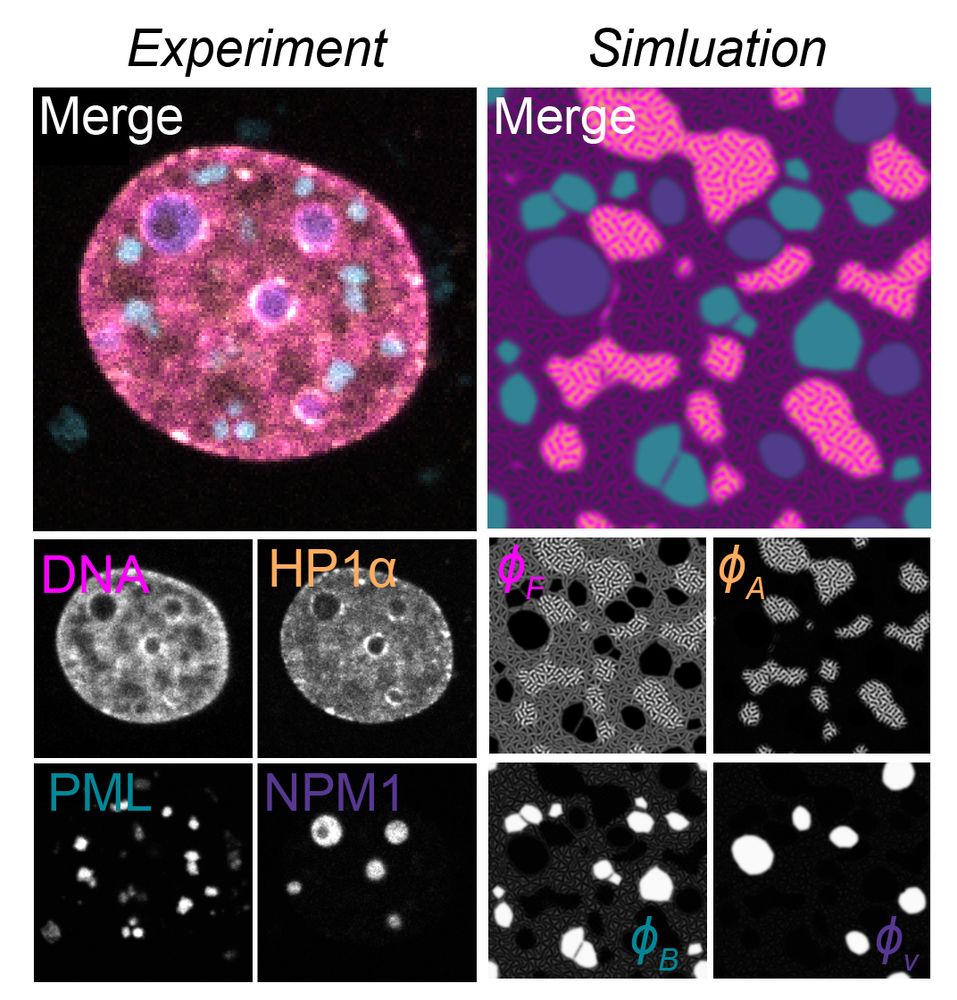
The structure of condensates and chromatin are interdependent.
Surface tension and stiffness– not just binding affinity or location– shape genome structure.
Elastocapillarity offers a physical basis for mesoscale nuclear morphology, with implications for gene regulation and disease.
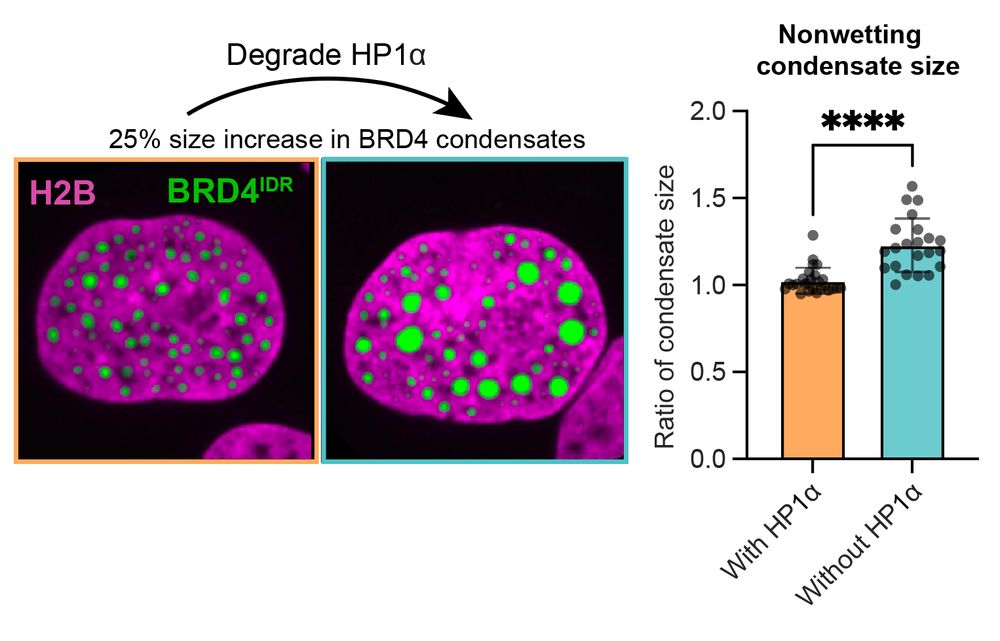
Multiple types of condensates coexist within one nucleus, potentially interacting mechanically through modulating the chromatin network– we found that wetting condensates bundle and stiffen chromatin, constraining the size of non-wetting condensates.
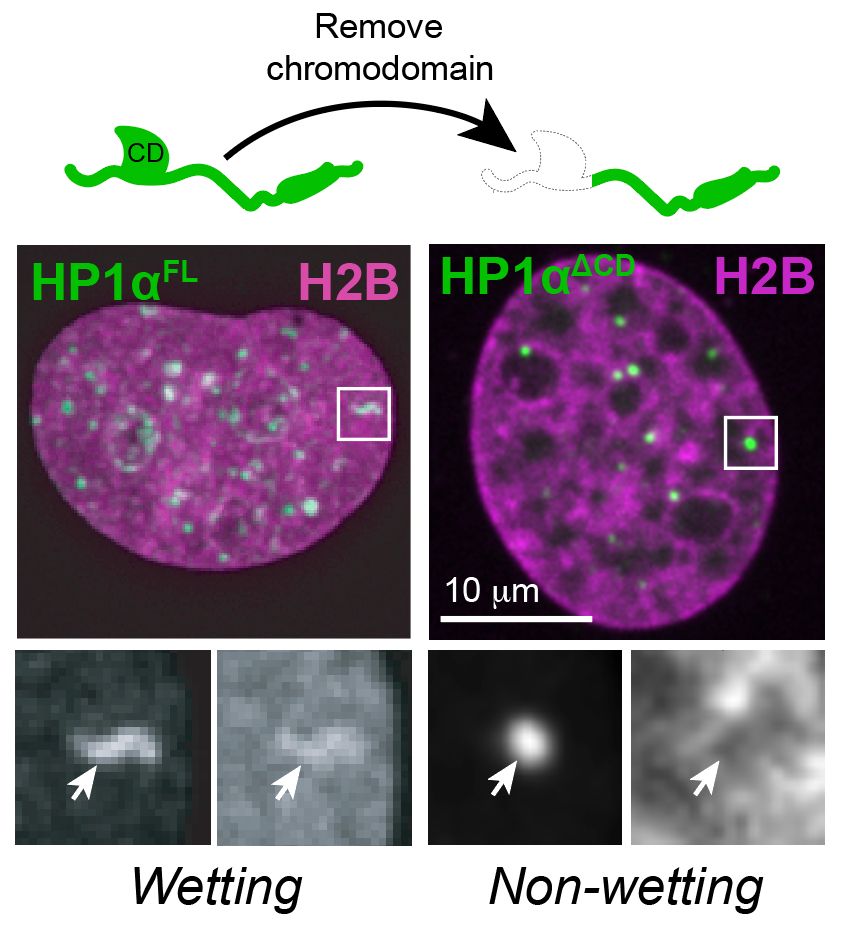
We investigated the determinants of condensate wetting and chromatin stiffness in living cells.
Stiffness arises from chromatin density, while wetting is controlled by the strength and extent of chromatin binding, with heterochromatic protein HP1alpha’s chromodomain providing strong wetting
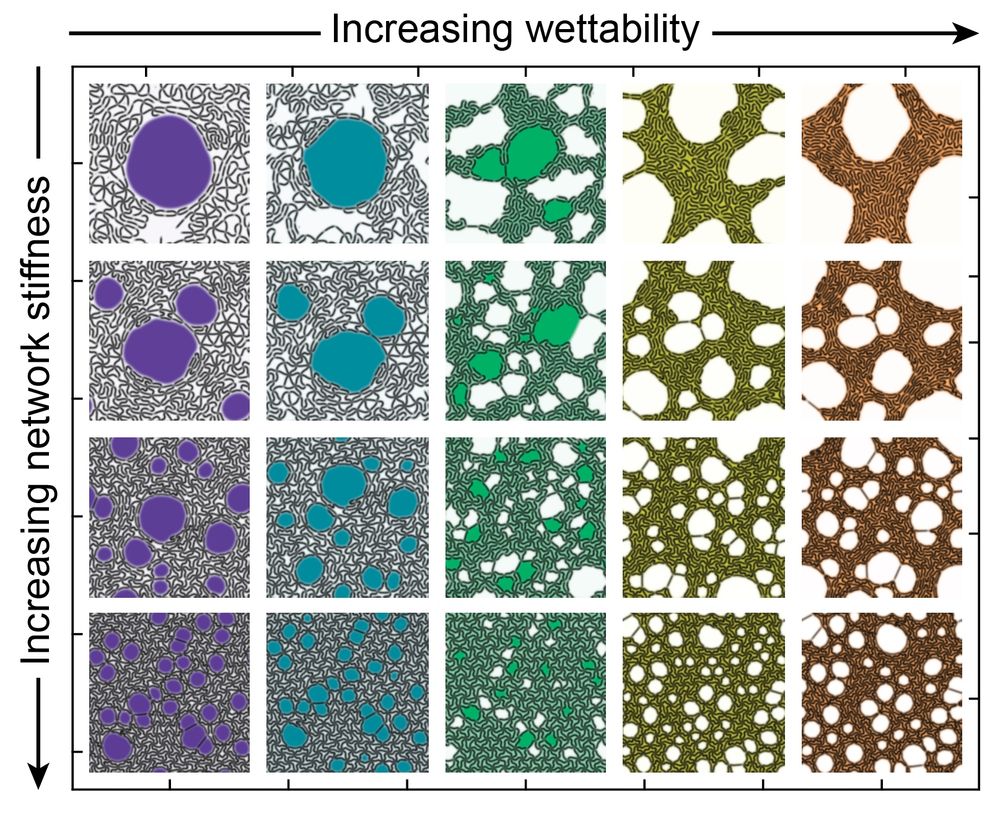
Elegantly, the variety of morphologies seen in nuclei can arise from varying just two parameters– condensate wetting and chromatin stiffness.
Nonwetting condensates in flexible networks cavitate and exclude fibers, while wetting condensates engulf and bundle them. Stiff networks inhibit growth.
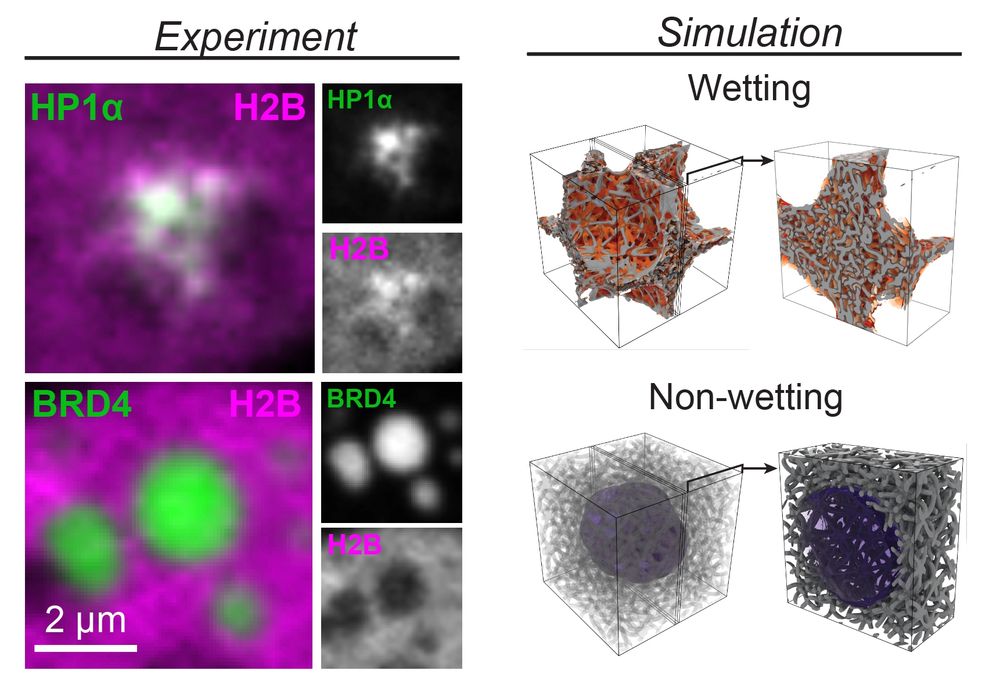
Through simulations and experiments of a chromatin fiber networks and liquid-like condensates, we revealed that both chromatin-including, aspherical structures and chromatin-excluding, spherical structures seen in the mesoscale nucleus can be recreated through elastocapillarity
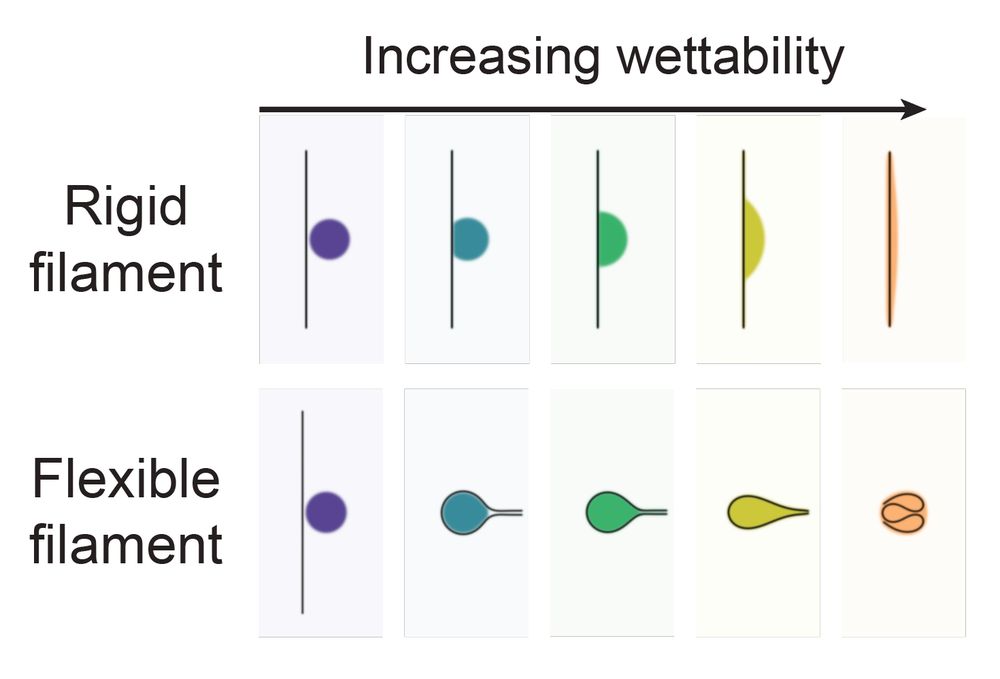
Liquid-fiber interactions– governed by the physical principle of elastocapillarity– are invoked when liquids adhere to flexible structures like membranes and microtubules. The liquid can influence the shape/structure of the fiber, and vice versa.
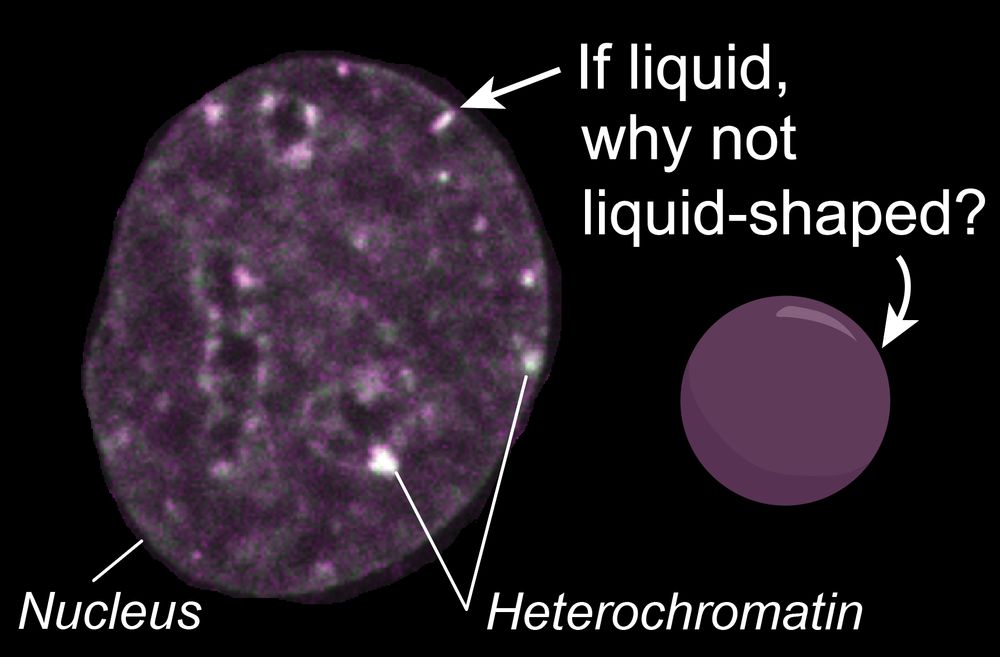
If heterochromatin is really a liquid-like condensate, why is it not spherical?
We investigated whether mechanical interactions between a condensate and a fiber network can explain the variety of morphologies seen in phase-separated nuclear compartments
www.biorxiv.org/content/10.1...
