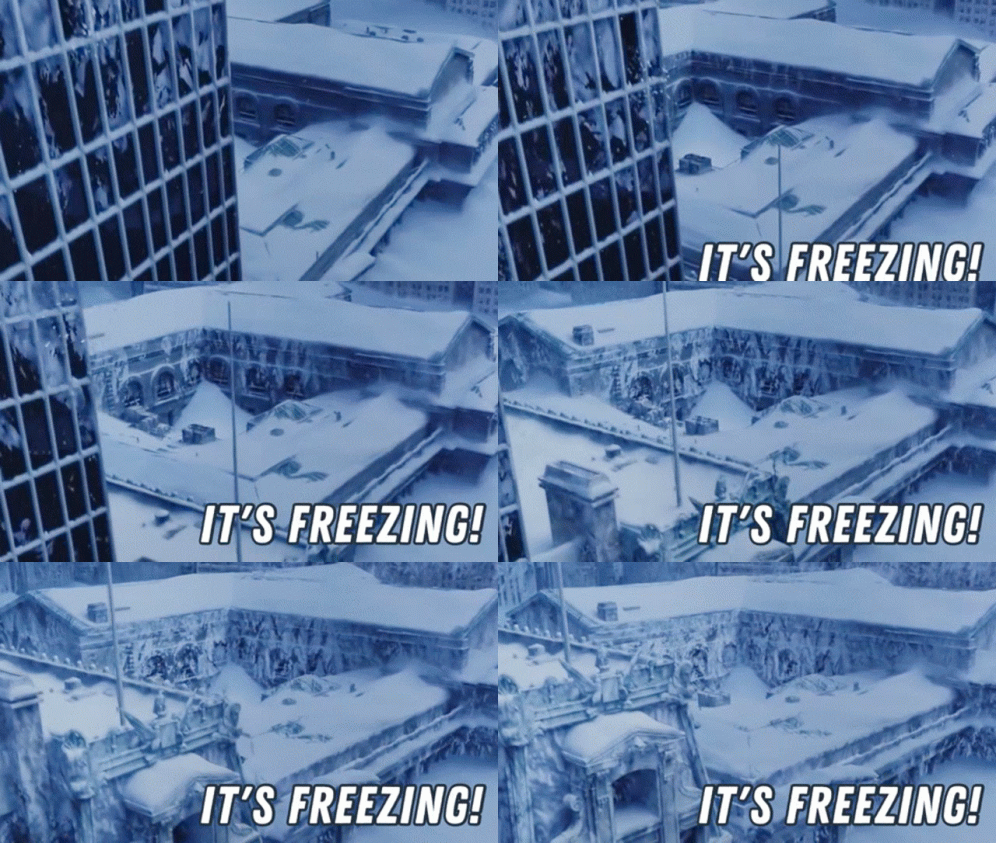
a building with a lot of windows is covered in snow and ice
ALT: a building with a lot of windows is covered in snow and ice
If you were taking a college course called “Science Fiction or Science Fact?” that focused on critiquing the science in movies, what movies would you want to watch?
Twister?
The Day After Tomorrow?
Jurassic Park?
Toss me some ideas!
28.01.2026 22:33
👍 1
🔁 1
💬 2
📌 0

I had a lovely dinner last night with some esteemed senior ladies in glaciology that I’m lucky to call friends. From left to right: Helen Fricker, Ginny Catania, Sophie Nowicki, Leigh Stearns, Twila Moon, & me! #AGU25
16.12.2025 12:02
👍 14
🔁 0
💬 0
📌 0

Come talk to me at #AGU25 this week & work towards a chance to win $100 through Cryosphere BINGO! I’m chairing Remote Sensing of the Cryosphere sessions on Mon & Tues and giving a talk in session C34B on Wednesday!
14.12.2025 16:05
👍 6
🔁 1
💬 0
📌 1


Highlights from the end of the year @BoiseState (so far): celebrating university awards w/ awesome grad students, getting a teaching award from grad students at our dept. picnic, & getting a gift for “badgering” students to do required paperwork
03.05.2025 12:17
👍 2
🔁 0
💬 0
📌 0

Just 2 Associate Professors (me + Jenn Mallette) celebrating the end of the Fall ‘24 semester with a 6-mile Christmas run! I may not be fast but I toughed it out even with a bad case of laryngitis. #Boise @boisestate.bsky.social
21.12.2024 18:33
👍 7
🔁 0
💬 0
📌 0

a football field with the words let 's in red
ALT: a football field with the words let 's in red
When your football team has their conference championship game at 6pm and your office is next to the stadium (behind the fireworks in the gif), you need to be prepared for an afternoon full of stadium music while you work! At least I’ll be pumped up!
06.12.2024 16:27
👍 5
🔁 0
💬 0
📌 0

Fall CryoGARS Glaciology group photo! I always try to build a sense of community in my group & part of that effort includes hosting a group party each semester. No undergrads were free but all my grads came: (L to R) Aman K C, Rainey Aberle, Karina Zikan, Parker Wilkerson, & Lindsay Summers
19.11.2024 15:26
👍 7
🔁 0
💬 1
📌 0

Slowdown of the Motion of the Ocean - NASA Science
In Brief: As the ocean warms and land ice melts, ocean circulation — the movement of heat around the planet by currents — could be impacted. Research with NASA satellites and other data is currently u...
I lectured on my research to an intro geoscience class yesterday. I had 2 students stay after to ask about impacts of land ice loss beyond sea level rise. I told them about slowing global ocean circulation & I think I depressed them. But maybe I also inspired them? science.nasa.gov/earth/earth-...
25.10.2024 17:20
👍 4
🔁 2
💬 0
📌 0
I have put entirely too much thought into how I can justify wearing a #Halloween costume while teaching my Remote Sensing & Meteorology classes. I’m hoping I don’t suddenly become “internet famous” in a little less than 2 weeks! #eccentricprofessor
19.10.2024 01:17
👍 1
🔁 0
💬 0
📌 0

We thought our one seismometer kept getting “visited” by a bear, but I’m starting to think that maybe it was a wolverine that chewed up our box & lost one of our sensors (rolled off a cliff?)… @timbartholomaus.bsky.social #fieldwork #science
17.10.2024 18:19
👍 9
🔁 1
💬 1
📌 0
If you’ve ever heard of a “glacier surge”, you were probably told that it’s something like flipping a switch: a glacier goes from moving slowly to suddenly moving 10-100x faster. PhD candidate Jukes Liu’s latest paper shows it’s not that simple! bit.ly/48wciHrM
11.01.2024 23:26
👍 3
🔁 0
💬 1
📌 0

Figure 3. Glacier surface speed from 2013 to 2022 at points along the centerlines, labeled by km-distance from the terminus and grouped by spatial zones (Fig. 1). Surface speeds are plotted as rectangular patches with widths corresponding to the time period covered by the velocity maps and heights corresponding to the stable surface errors. Vertical grid lines mark 1 January of each year. The gray box bounds the 2020–2021 surge and the shaded portion corresponds to the period of surge front propagation to the terminus. Arrows in panels b and c emphasize multiyear patterns in speedup. Inset in panel b is an idealized diagram of the down-glacier propagation of seasonal speedups in the reservoir zone. Panel d shows the terminus area (blue, secondary y-axis) along with receiving zone speeds.
🚨🚨 New work I suspect will be influential for yrs to come!
Surge-type glacier Sít’ Kusá is far from quiet during "quiescence." @glacierdoc.bsky.social student Jukes Liu shows, using dense 🛰️ time series, that annual speedups w/ impt responses to weather, build towards surge doi.org/10.1017/jog....
09.01.2024 17:57
👍 5
🔁 2
💬 1
📌 0