

And of course we also thank and congratulate the authors of the excellent paper, Namba et al, @yuki-okada.bsky.social: www.nature.com/articles/s41... 🤩
05.03.2026 11:59
👍 0
🔁 0
💬 0
📌 0
And of course we also thank and congratulate the authors of the excellent paper, Namba et al, @yuki-okada.bsky.social: www.nature.com/articles/s41... 🤩

Huge thanks to @kauralasoo.bsky.social who stepped up with baby in his arms to lead the discussion of a complex JC paper picked and co-prepared with Maris.
Brilliant science, collaboration, real kindness, stepping up for each other, and family first. We need more role models like this. 🫶

Our paper on detecting GWA signals from neural networks is now published. Here we propose a model- and score-agnostic post hoc framework to detect potentially associated loci from neural networks trained for phenotype prediction.
academic.oup.com/nargab/artic...

Save the date! The Long‑Read Sequencing Uppsala Meeting (#LRUA26) is happening Nov 2–4, with a great lineup of invited and selected speakers
Stay tuned — registration and abstract submission will open soon🧬🖥️
lrua.se

✨ A new star allele was born! Excited to share our first in vivo pharmacokinetic recall study involving 114 participants from @ESTbiobank with previously uncharacterised variants in CYP2C19 and CYP2D6:
www.nature.com/articles/s41... #Pharmacogenomics @pharmvar.org @clinpgx.org
Good Q! We have just started digging into our first 5000 long-read genomes, stuck at annotation of SVs (VEP)... I’m not aware of any databases for SV associations besides clinical ones (DECIPHER, NCBI dbVar, ClinGen Dosage Sensitivity Map) and general pop freq db (gnomAD SV, IGSR, DGV, HSVC).
Could you take on structural variants next? 🙃

🧬 New preprint alert! After years of collaborative work across 52 datasets we are presenting eQTLGen phase 2: a genome-wide eQTL meta-analysis covering 43,301 blood samples: www.medrxiv.org/content/10.6... (1/8)

New study of 800K+ genomes from gnomAD reveals most “pathogenic” variants in healthy people aren’t truly disease-tolerant. They are explained by annotation errors, mosaicism, or compensatory variants. 🧬
A big step for precision medicine!
www.nature.com/articles/s41...

1/7 New BMI GWAS out! Using Estonian Biobank (n=204,747) and replication in FinnGen, we show that even in Europe you can still find region-specific biology if you zoom into population-tailored sumstats. Big thanks to co-author @kanwalbatool.bsky.social :)

#PacBio announces major upcoming advances for #Revio and #Vega designed to lower genome costs, expand multiomic capabilities, and support regulated research.
The SPRQ-Nx chemistry, now in beta access, delivers complete genomes for under $300 at scale.
View the press release: bit.ly/4o06eyH

The Open Targets Platform autumn release is out! 🍂
We have ingested the full dataset of over 13 million enhancer-gene regulatory interactions in the human genome across 1,458 DNase-seq experiments covering 369 cell types and tissues from the ENCODE-rE2G model
blog.opentargets.org/open-targets...
Maybe! Need to look into it :)
See you all next year for the 25th #GeneForum and some Estonian music! #plusskoor


And so many other excellent speakers like @srubinacci.bsky.social @stevesphd.bsky.social @hilarycmartin.bsky.social & many more who made it an awesome conference - now called mini-ASHG (by Hilary Martin) and we loved it 🥰

🧵 The summer of 2025 has been AI's "cruel summer"—wrongful deaths, dangerous therapy chatbots, medical misinformation, facial recognition failures. These aren't isolated glitches but predictable harms from systems deployed without adequate oversight. www.science.org/doi/10.1126/...


2nd day opened with a BEAUTIFUL talk by @nickywhiffin.bsky.social about ReNu variants playing such a huge role in developmental disorders despite the few bases..!


So excited about this year’s Gene Forum in Tartu being kicked off now by our keynote speaker @eimearekenny.bsky.social 🤩
Huge congrats @klehto.bsky.social on this achievement!! Her work has already enriched the @estbiobank.bsky.social and will continue to do so! 💙🖤🤍

🚨 Our parent-of-origin study is out in Nature! 🧬
Maternal and paternal alleles can have distinct — even opposite — effects on human traits, revealing a hidden layer of genetic architecture that standard GWAS miss.
🔗 www.nature.com/articles/s41...
Highlights below!
Huge thanks to Maris Alver for leading this important work, and for the rigorous and thoughtful data analysis together with Silva Kasela, Laura Birgit Luitva and Kristi Krebs!
3. Polygenic and pharmacogenomic predictors contributed independent and additive effects to dose variation.
This work underscores the potential of integrated genetic approaches to support more personalized and data-informed prescription of medicines.
2. GWAS picks known PGx associations independent of the underlying trait PGSs.
• Strong peaks for metoprolol (CYP2D6) and warfarin (VKORC1, CYP2C9)
• PGx genes enriched among GWAS top signals for statins.
🧬 Key insights:
1. PGSs for complex traits reveal both biological and healthcare-related influences on medication dosing
• High genetic predisposition -> higher dose
• BMI PGS linked with dose variation across several drug classes
• EA PGS linked to lower statin and higher antidepressant doses
Using prescription data from 212,000 @estbiobank.bsky.social participants, we examined how polygenic scores #PGSs and #pharmacogenomic variants relate to variation in medication dosing for metoprolol, warfarin, statins, antidepressants, and antipsychotics.

📢 (on more!) New study from our team in the Journal of Translational Medicine:
Polygenic and pharmacogenomic contributions to medication dosing: a real-world longitudinal biobank study
🔗 tinyurl.com/25u3a5j7
(thread below) 👇

🎉(1/4) Excited to share that our latest paper is now published!
We investigated genetic factors linked to antidepressant side effects in 13,000 individuals from the @estbiobank.bsky.social , leveraging data from questionnaires and clinical notes using NLP.
www.nature.com/articles/s41...

New preprint! My (now former) postdoc @kvastad.bsky.social led this integration of GWAS and spatial transcriptomics (ST) data to identify tissue structures with enrichment of disease-implicated genes = likely causal drivers of disease biology.
www.biorxiv.org/content/10.1...

Our ability to predict a person's risk of heart disease keeps getting better, even among those previously considered at low risk by traditional clinical criteria
@naturemedicine.bsky.social by my team @scripps.edu
www.nature.com/articles/s41...
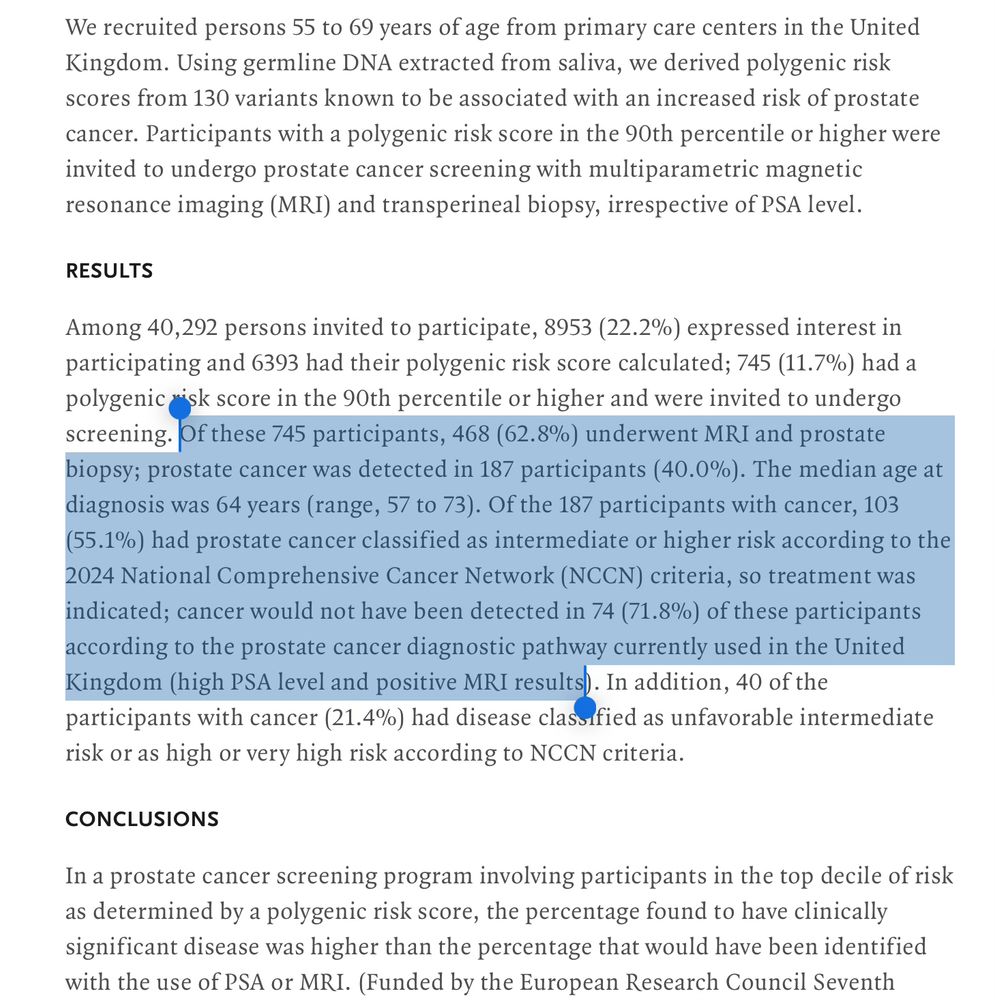
This study is a big deal. Is it going to be the one that kicks down the PRS door? Maybe. And that’s saying something.
Assessment of a Polygenic Risk Score in Screening for Prostate Cancer www.nejm.org/doi/full/10....
