
Me, 7 graduate students, 1 postdoc and 3h per week of a research professional. All students know they have to chip in for lab tasks, but it works well.
26.11.2025 23:47
👍 1
🔁 0
💬 0
📌 0
Me, 7 graduate students, 1 postdoc and 3h per week of a research professional. All students know they have to chip in for lab tasks, but it works well.


We're hiring! My dept. is looking for a candidate with a research program focusing on plant systems. All areas of molecular and cellular biology research will be considered. Not sure if you'd fit? Reach out to me. Please share! #microsky

C’est un départ pour le BiSP/Micrhub! Plus de 150 participants pour jaser de bactériologie en français. @vincentlamoureux.bsky.social ouvre le bal avec ses résultats de post doctorat en métabolomique! @micrhub.bsky.social
De très belles journées de science en français s'en viennent!


Offre de MSc avec @pbbeauregard.bsky.social Mirella Aoun et moi #agriculture #durable #écologie #microbienne
Open MSc position #sustainable #agriculture #microbial #ecology
Un partenariat entre Bishop's University & @usherbrooke.bsky.social
C'est le temps d'appliquer! 🕐🤩
Time to apply! 🕐🤩
My vintage protocol uses the sodium salt for glutamic acid, and the pH of the MOPS stock solution is adjusted with NaOH. So, the final medium contains a mix of both. We also recently observed that the exclusive presence of K vs Na changed the phenotype of the colony.
Nous aurons le plaisir d'accueillir Géraldine Laloux (UCLouvain) et Jesse Shapiro (Université McGill), et il y aura de multiples possibilités de présentations et d'affiches. Suivez @micrhub.bsky.social pour des mises à jour, et l'inscription est ici : event.fourwaves.com/fr/bispmicrh...
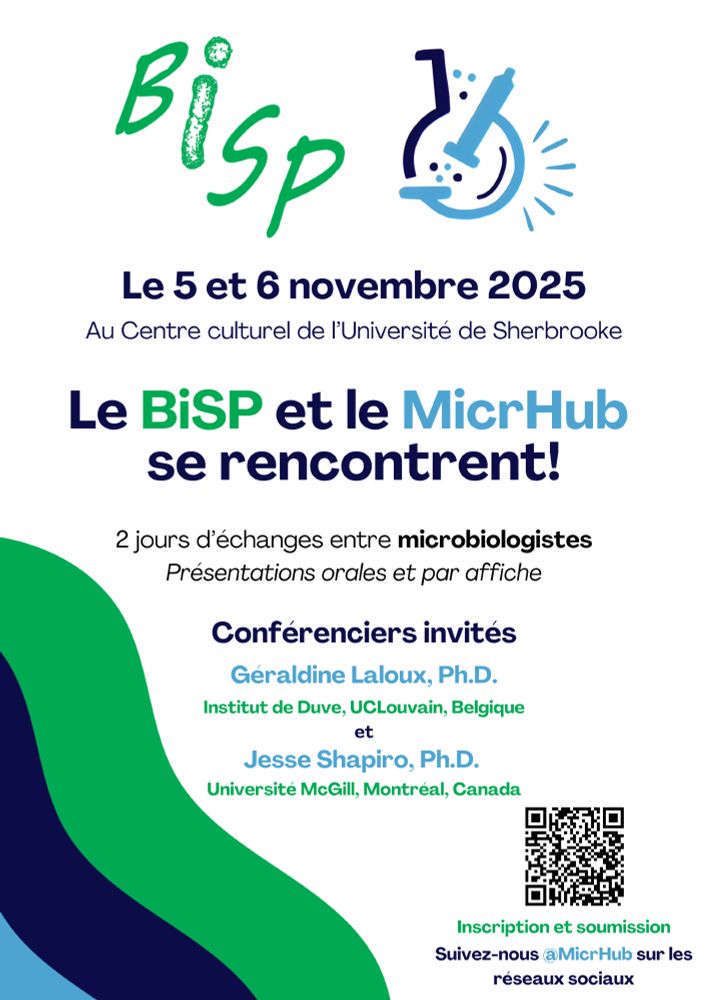
Réservez les dates! Le BiSP (bactériologie intégrative, symbiose et pathogénèse) aura lieu le 5 et 6 novembre à l'Université de Sherbrooke - un événement qui sera en "symbiose" avec le MicrHub, rencontre annuelle de tous les microbiologistes de Sherbrooke. À ne pas manquer!

Le groupe de Biologie Moléculaire du Département de Biologie recrute!
Une 4e embauche en 2 ans, joignez-vous à une équipe jeune, à un département dynamique, au sein d'une institution exceptionnelle, dans un pays démocratique.
www.usherbrooke.ca/emplois/offr...
Pour pallier à mon anxiété (merci Trump) je cuisine. Donc aujourd’hui j’ai fait des “baked oats cup”, des chips pita au zaatar, un pain au levain, une soupe poulet nouille pour les lunch et des brownies. Ça va vaguement mieux?
Interesting! I have never seen that before. No idea what/why it is different!!
We use Na-glutamate but I am unsure if it makes a difference. This could help : journals.asm.org/doi/10.1128/...
My take is that the brown pigment is this spore-associated thing, and it depends on pulcherrimin since pulch is required for correct colony development. Some pulch is likely there too.
Or it could be partially complexed pulcherriminic acid (so a bit of pulcherrimin + free pulcherriminic acid) - pulcherriminic acid is soluble.
To me, left is typical pulcherrimin, red and insoluble. Right is a "brown pigment associated to spore" (no idea what it is exactly) that we observe sometimes (our colonies on MSgg secrete red pigment). It could be dependent of Fe and pulcherrimin because both are required for B. subtilis biofilm.
#proudPI #alittletirednow
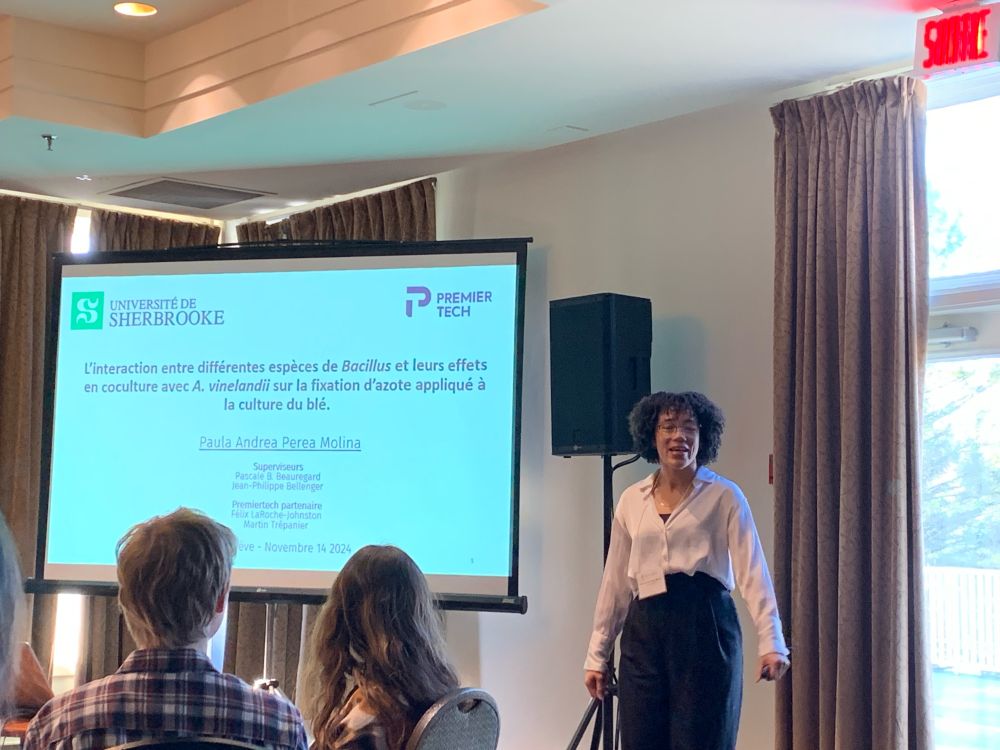
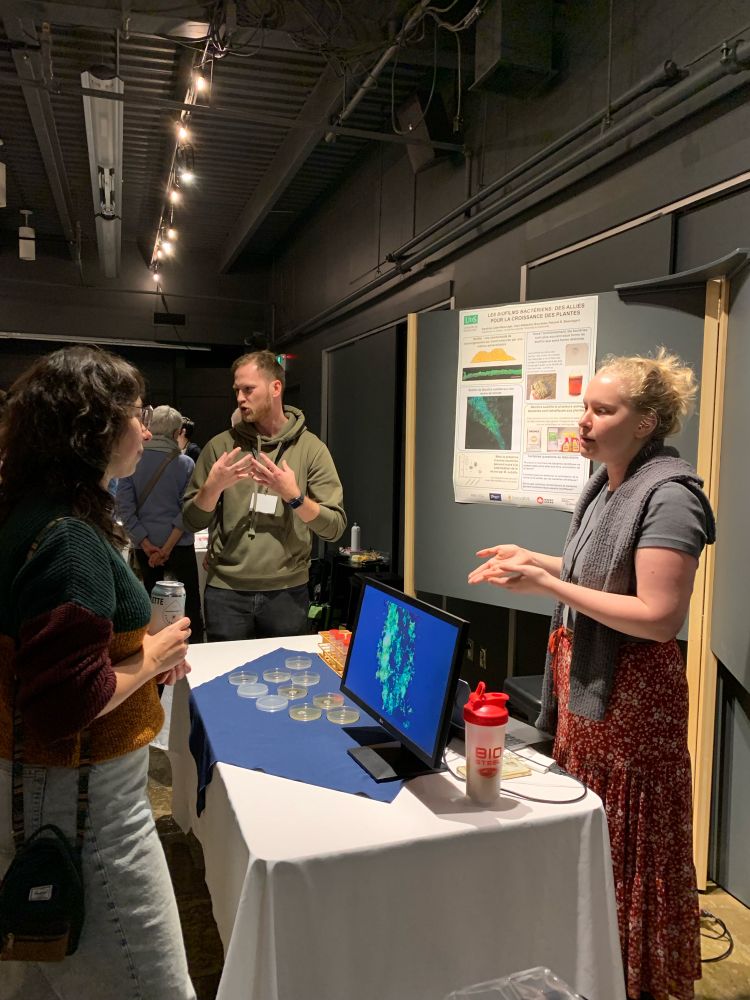
Busy week! Paula did an excellent job presenting her project (in her third langage - french!) to the Centre Sève on thursday, on Bacillus species helping or not N fixation. Then, JS, Sandrine and I talked about our research at La nuit des chercheurs hosted by the Science museum of Sherbrooke.
Toujours un plaisir d’aller discuter des plantes sous tous leurs angles aux Journées du #CentreSEVE !

Starting off the annual #CentreSEVE meeting with @balachaudhary.bsky.social on mycorrhizal dispersal
Congrat Julie for your article, great work!
In presence of high N, B. subtilis negatively impacts A. vinelandii growth; in low N, A. vinelandii feed N to B. subtilis, which in return strongly stimulates Azoto N-fixing activity. Another great collaboration with my chemist colleague JP Bellenger!
New article alert! Here, PhD student Julie Leroux elegantly shows how N availability influences the interaction between a diazotroph, Azotobacter vinelandii, and our favorite PGPR Bacillus subtilis. journals.asm.org/doi/10.1128/...