
Please sign the Petition to stop the job cuts to Geology and Palaeontology degrees in Leicester www.change.org/p/save-geolo...
19.11.2025 08:31
👍 2
🔁 1
💬 0
📌 0
Please sign the Petition to stop the job cuts to Geology and Palaeontology degrees in Leicester www.change.org/p/save-geolo...


You can’t miss the article Emma wrote in memory of Kike Ballesteros for the 9th Environmental Conferences of the Balearic Islands 🙌🏽✨🩵
jornades.shnb.org/wp-content/u...
@emmacebrian.bsky.social @ceabcsic.bsky.social @iea-udg.bsky.social @medrecover.bsky.social

Recortes en las protecciones marinas de España ponen la biodiversidad y las pesquerías en riesgo @efeverde.com
efeverde.com/cdoverde-rec...
El Ministerio de Agricultura, Pesca y Alimentación recorta en un 40% el presupuesto dedicado a las reservas marinas, dejándolas parcialmente sin vigilancia

Alessia Logrieco realiza una estancia en el Grupo de Cambio Global, Conservación y Genética del IATS-CSIC
iats.csic.es/alessia-logr...
@dicv.csic.es

So happy to be featured in @tagesspiegel.de and share our work with coral reefs in @freieuniversitaet.bsky.social and MaCoBioS!
@jpdolivo.bsky.social @diegokersting.bsky.social @leinre.bsky.social @mjvergotti.bsky.social @geobio.bsky.social
Special thanks to Kara Mikus for this great article!

Hier ein weiterer Artikel zu unseren Riffarbeiten im @tagesspiegel.de: Feature zu Mitarbeiter/Doktorand Gabriel Cardoso (von Kara Mikus) www.tagesspiegel.de/themenspezia...
@gabrielcardosoeco.bsky.social @diegokersting.bsky.social @jpdolivo.bsky.social @mjvergotti.bsky.social @geobio.bsky.social
Long-standing marine reserves need continued support
Spain’s marine reserves, managed by the Ministry of Agriculture, Fisheries and Food, have suffered a 40% budget cut leaving them partially unprotected.
Letter to the Editor @nature.com
rdcu.be/eHJtR
@cristinalinares.bsky.social @mjvergotti.bsky.social @jpdolivo.bsky.social @coralmannie.bsky.social @comunicacion.iats.csic.es

New OA paper out! We present the most accurate coral d18O-temperature equation, reconstruct coral trophic dynamics in the Med for the first time, and show #Cladocora skeletons are key archives for reconstructing anthropogenic warming and impacts.
@aslo.org @dicv.csic.es
doi.org/10.1002/lno....

Hoy os traemos una noticia sobre la estudiante de doctorado Nagore Quintano, quien evalúa la actividad fotosintética de los simbiontes del coral mediterráneo ‘Cladocora caespitosa’
iats.csic.es/nagore-quint...
@diegokersting.bsky.social @nagoreqf.bsky.social @dicv.csic.es

New paper alert 📚🚨‼️
Reconstructing skeletal growth records from the Brazilian endemic coral Mussismilia braziliensis (1926-2015; the longest record in the SWA) reveals cross-shelf differences in local and climatic growth drivers in Abrolho’s turbid-zone reefs.
authors.elsevier.com/c/1lhsm_6Cxq...

The first paper of my phD is out!🔬
🪸 May Cladocora caespitosa corals living in nutrient-rich waters be more tolerant to thermal stress?🌡️ Find out more on: www.researchgate.net/publication/...
Very thankful for the guidance of my supervisors @diegokersting.bsky.social and @cristinalinares.bsky.social

First paper of @nagoreqf.bsky.social PhD!👏
Long-term monitoring reveals local nutrient conditions shape #Cladocora resilience to 🌡️. First results of #GeneraciondeConocimiento project #UndResCoral
link.springer.com/article/10.1...
@cristinalinares.bsky.social
@ageinves.bsky.social
@dicv.csic.es

What can ancient corals teach us about the future? 🪸
Our new study with Markus Reuter looks back millions of years to see how reef corals responded to past climate stress. Their story may hold clues for how modern reefs will cope with today's warming oceans. www.nature.com/articles/s43...

Incluso los corales más resistentes del mar Caribe tienen su supervivencia amenazada por el aumento de la temperatura. Es la principal conclusión de un estudio donde participa personal investigador del Instituto de Acuicultura Torre de la Sal (IATS), centro del Consejo Superior de Investigaciones Científicas (CSIC) en Castellón. Tras analizar más de un siglo de evolución de una especie de coral resistente a las altas temperaturas, Siderastrea siderea, en varias zonas de la isla de Martinica, el equipo de investigación observó que estos corales no se han recuperado de las olas de calor recurrentes desde los años 80. Además, la densidad de sus esqueletos cayó entre 2010 y 2020, lo que sugiere que estos corales han superado su “límite térmico” para crecer adecuadamente. Los resultados se publican en Scientific Reports, revista de acceso abierto de Nature. Los corales son animales marinos emparentados con las medusas. Son tan abundantes y esenciales en la formación de los arrecifes que les dan su nombre. Los corales constructores de arrecifes forman esqueletos de carbonato cálcico (como nuestros huesos), lo que da estructura al arrecife y crea hábitats para una enorme diversidad marina. Mantener esta estructura durante siglos depende en gran parte de la velocidad con la que los corales depositan su esqueleto. Pie de foto: El coral masivo Siderastrea siderea en el arrecife Caye d’Olbian, Martinica. Foto: Ewan Trégarot.
Un estudio en el que participa el Instituto de #Acuicultura Torre de la Sal ( @csic.es ) demuestra que incluso los corales más resistentes del Caribe tienen su supervivencia amenazada por el aumento de la temperatura.
@diegokersting.bsky.social
delegacion.comunitatvalenciana.csic.es/el-calor-ame...
🌊El calor amenaza incluso a los corales más resistentes del Caribe, según un estudio con participación del #CSIC
☀️Han analizado más de un siglo de evolución de una especie de coral
💧Se ha superado el "límite térmico" para que crezcan adecuadamente
👉http://tiny.cc/193q001

📢 ¡Queda poco!
#CEAB @csic.es y @medrecover.bsky.social sacamos la Beca Predoctoral Kike Ballesteros 💙 Con la ayuda del programa Pristine Seas 🌊
💥 ¿Quieres hacer tu tesis sobre biodiversidad marina?
A month-long summer sea temperature anomaly of +2C is enough to kill most coral species on the Great Barrier Reef.
+8C in the Mediterranean will devastate marine ecosystems.
SST anomaly in the Catalan Sea breaks records. A compact mass of water with a surface temperature higher than 29ºC occupies the central part of the Balearic Sea. At the regional level, the water reached, at the beginning of the month, a higher temperature than that of the warmest peak of 2024.🧪🌊

Our new paper on the range of adaptability of a Caribbean coral to anthropogenic impacts has been published today in Nature Scientific Reports; lead author is
@gabrielcardosoeco.bsky.social 🧪 1/2
www.nature.com/articles/s41...
Very happy to see this paper published! One of the chapters of
@gabrielcardosoeco.bsky.social PhD thesis. Great job Gabriel! #proudsupervisor
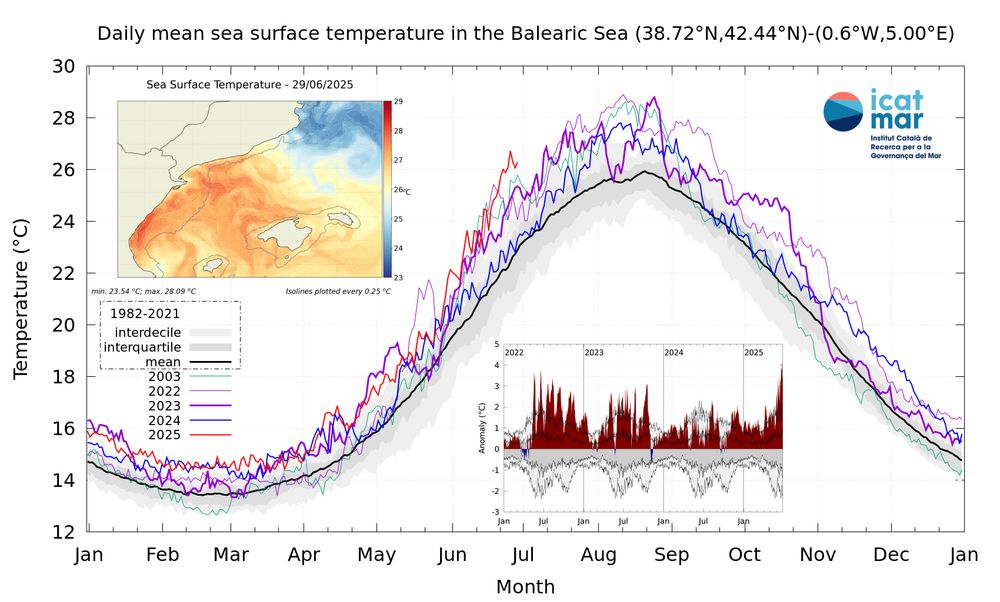
Look at the red line! It is the current SST in the Balearic Sea. A highly concerning start to summer 2025...
@icatmar.bsky.social
@justino.info
Ein neues Beispiel für die Rolle der Columbretes-Inseln als Beobachtungszone des globalen Wandels: Dort liegen Datenreihen zum globalen Wandel vor, die über mehr als 20 Jahre zurückreichen
@dicv.csic.es @csic.es

🪸Selbst abgelegene Korallenriffe im Mittelmeer sind massiv mit Mikroplastik belastet. Das zeigt eine neue Studie der @uni-kiel.de: In der Bucht von Illa Grossa (Spanien), einem streng geschützten Naturschutzgebiet, wurden in Proben mehr als 6.000 Partikel pro Kilogramm Sediment gefunden.
Mehr Infos👇

High levels of microplastics in a mediterranean Cladocora coral reef, situated in a remote, protected area. (In Marine Pollution Bulletin, online first)
www.sciencedirect.com/science/arti... (by Lars Reuning, Lars Hildebrandt, @diegokersting.bsky.social, Daniel Pröfrock)
Científicos del Instituto de #Acuicultura Torre de la Sal @csic.es detectan concentraciones excepcionalmente altas de #microplásticos en las Islas Columbretes.
@agenciasinc.es @efe.com @comunicacion.iats.csic.es @diegokersting.bsky.social
delegacion.comunitatvalenciana.csic.es/detectan-con...

Hoy, en la sección de Sala de Prensa de nuestra web, nos hacemos eco de la nota de prensa “Detectan concentraciones “excepcionalmente altas” de microplásticos en las Islas Columbretes” publicada por la @dicv.csic.es @diegokersting.bsky.social

#Pinna larval collectors installed again in #Columbretes
We continue efforts to keep this long-term data series running. Part of the Pan-Mediterranean Pinna Larval Collectors Network, focused on assessing the recovery of the species
@dicv.csic.es @comunicacion.iats.csic.es

Spring sampling #UndResCoral Generación de Conocimiento project in Columbretes undertaken succesfully!
We also worked on our long-term #Cystoseira data series, hoping to obtain funding to keep working on these declining communities
@dicv.csic.es @comunicacion.iats.csic.es @ageinves.bsky.social
📌 En el concurso general de traslado de 19-05-25 se ofertan dos plazas para el IATS: Colaborador/a de I+D+i y Ayudante de I+D+i
📌 Este concurso es para personal funcionario
📌 El plazo para presentar la solicitud es de quince días hábiles a contar desde el 20 de mayo de 2025
@dicv.csic.es

