
Four worlds around a small, dim star are challenging theories of planet formation
12.02.2026 20:26
👍 48
🔁 11
💬 0
📌 3

@mlformsplanets
Postdoc at the Institute for particles physics and astrophysics, ETH Zürich, Switzerland | studying the evolution of sub-Neptunes | formerly at Globe Institute, University of Copenhagen, Denmark | 🌈
Four worlds around a small, dim star are challenging theories of planet formation
🧪🔭⭐ #exoplanets #exoplanet #youngplanets
New paper from our group and @madysonbarber.bsky.social today!
We report a brand-new planet around a <50 Myr star—adding to a very small (but rapidly growing!) population of the youngest known transiting planets.
Paper: arxiv.org/pdf/2511.10734

Very exciting paper on arXiv today: arxiv.org/abs/2509.17231. The best evidence yet for a secondary atmosphere on an ultra-hot super-Earth. 🔭🌋 Very surprising given the theoretical predictions of rapid atmospheric escape ("cosmic shoreline") on these planets; [...]

A close-up photo of a box of cupcakes with gold candles spelling out ‘6000’.

A group of smiling people - scientists, engineers, data analysts and writers - standing behind a table of goodies.
Sometimes 2025 just feels like a lot, and you need an excuse to celebrate your fabulous team (and the whole exoplanet community!) reaching a new milestone…
Happy 6,000 Confirmed Exoplanets Day, everybody!!!!
(You may recognize the narrator of the video at the link! 🫣)
www.nasa.gov/universe/exo...

The Path

Do you love WASP-107 b? Do you love making use of *both* ground VLT + space JWST obs to detect molecules in a "warm" (Teq<800K) #exoplanet in transmission, even in a crazy confusing cloudy atmosphere?!
🚨 It's PAPER* DAY! Which means #scicomm thread!
🧵⬇️🔭🪐🧪
*pre-print!
arxiv.org/abs/2508.18964

A white protoplanetary disc at the centre of the picture takes up most of the frame. The elliptical cloud of dust and gas consists of some gaps creating a ring-like structure to the cloud. In one of the larger gaps/rings a little dot (a planet) is visible.
A very hungry planet! 🪐
What appears to be a ripple in space is actually a newborn planet, eating its way through its dusty cradle around a younger version of our Sun 🌞
Read more: https://www.eso.org/public/images/potw2534a/
🔭 🧪 #exoplanets
📷 ESO/R. van Capelleveen et al.

Kepler mission: smaller stars have more short-period, small #exoplanets.
Theory: the smallest stars won’t have enough disk material to make small planets so there must be a turnover.
Kepler+K2: We have found a turnover!
Check out our newest Scaling K2 paper: arxiv.org/abs/2508.05734
🧵 1/9
🔭🧪☄️
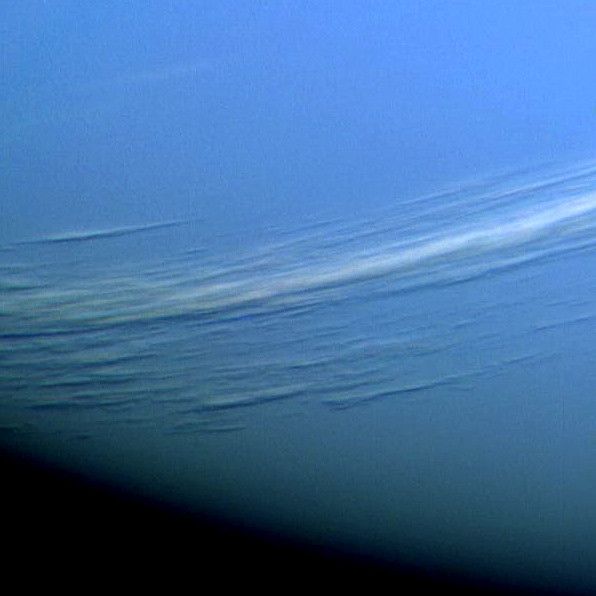
High-altitude clouds on Neptune.
Photographed by the Voyager 2 spacecraft on 25 August 1989.
I had a great time at #exoclimes last week, learning a lot, meeting new people, and catching up with old friends. Now, I'm off to the coast for hopefully a successful whale watching experience 🐳
New paper out! This is a review of the published JWST observations of rocky exoplanets so far: arxiv.org/abs/2507.00933
Quick summary of the key points:

An xkcd cartoon titled “Typical exoplanet system”. There’s a drawing of a star and several weird planets orbiting around it. The planets are labeled as follows: Giant planet orbiting so close that it’s actually rolling on the star’s surface. Hot Jupiter. Mini Neptune. Planet that could be habitable, if there’s a form of life that hates water but loves acid and being on fire. Cold Jupiter. Potentially habitable void. Hot Mars. Planet that may actually be in the habitable zone, according to a very optimistic modelling paper by some desperate postdocs. There’s a pulsar here but it’s probably fine. A water world paradise with beautiful oceans and warm- wait, no, we just got new measurements, it’s a hellish steam oven. Mini Pluto. Lukewarm Jupiter. Earthlike data artifact. Planet whose atmosphere is confirmed to contain atoms. Wet Saturn. Either a gas giant or a fist-sized rock, depending which calibration method you use. Faint dust cloud that will cause several papers to be retracted. Somehow this whole system is smaller than the orbit of Mercury?! Planet whose surface may host conditions suitable for rocks. Mouseover text: Sure, this exoplanet we discovered may seem hostile to life, but our calculations suggest it’s actually in the accretion disc’s habitable zone.
New exoplanet classification just dropped 🔭🧪
xkcd.com/3103/
![Comic. [yellow sphere with icon that reads, CHECK ENGINE] [caption] This new sunspot cluster has raised concern among astronomers.](https://cdn.bsky.app/img/feed_thumbnail/plain/did:plc:cz73r7iyiqn26upot4jtjdhk/bafkreifixtbs6xmvshoacqnxeqg2q5zpa5z4r36dcj2tz4wssavmfogmhe@jpeg)
Comic. [yellow sphere with icon that reads, CHECK ENGINE] [caption] This new sunspot cluster has raised concern among astronomers.
Check Engine
xkcd.com/3096/
I will be volunteering at the PlanetS exhibition at Fantasy Basel, the swiss comic con. I'm very excited to see such an event from the other side ☺️

Deep ALMA observations of 12CO emission from fifteen protoplanetary disks reveal a stunning range of structures in the gas morphology including gaps, rings and spirals. Credit: Richard Teague and the exoALMA Collaboration
I recently visited the ALMA observatory in Chile. While I was poking around the telescopes, ALMA researchers released amazing new views of planet-forming disks around young stars.
These are the most detailed images yet of new solar systems being born. 🧪🔭
public.nrao.edu/news/exoalma/

Just shared a new paper on the arXiv, led my @luiswel.bsky.social and me, on the challenges associated with detecting gases in exoplanet atmospheres. As the field pushes towards new and exciting opportunities, we thought it was time to talk about what it really means to “detect” something!
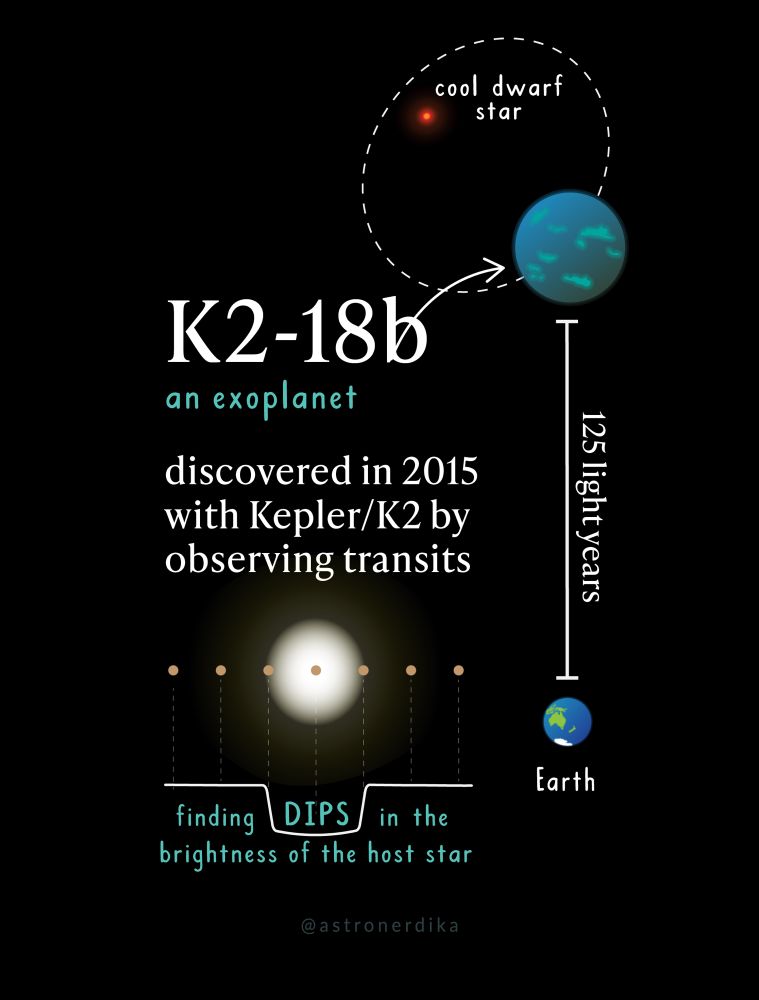
Infographic about the exoplanet K2-18b and its discovery with Kepler
So I know folks have heard the news about an exoplanet that might be “teeming with life”? 🌱
I created a series of infographics that aims to cover the key points of the research findings + some of the area where scientists are sceptical! 🧐
Meet K2-18b! 👋
#astronomy #exoplanet #scicomm

Mae Jemison wears a bright orange NASA space suit and holds her helmet for a photo
Since we’re all talking about it I want to blow up a real female space pioneer, Mae Jemison, an actual astronaut. She’s a graduate of Stanford and Cornel Medical School, served in the peace corps, started an educational nonprofit, and worked for the CDC researching vaccines. That’s a woman in space

I've also given out some globular clusters!
✨ Your star cluster is: Messier 2 ✨
It's so big and easy to see that it was discovered already in 1746. It's really old (12.5 billion years) and has tidal tails emanating from it that may be perturbed by the LMC iopscience.iop.org/article/10.3....
Is it only open clusters or can we also get globular clusters?
Congratulations 🎉
Congratulations!! 🎉


Ah yes, April Fool's day on arXiv. Enjoyed this one.
arxiv.org/abs/2503.22795
Advertisement!:
PhD-summer school at the Globe Institute, UCPH 18-22 August.
From interstellar dust to habitable planets and the conditions for life.
Interdisciplinary lectures with perspectives from astronomy, cosmochemistry, geology, and astrobiology.
For more see: www.dust2dna.dk

The DSS galaxy (a red blob)

The Euclid galaxy (you can now see arms! detail! it's amazing)
The new EULICD data release is AMAZING! 🔭
Here's a before / after of a random galaxy I found in one of the new images, comparing against the Digitized Sky Survey.
I highly recommend taking a look around on ESA Sky - it's fun! Link: sky.esa.int/esasky/?targ...

💫 We are all stardust. It takes millions of years for dust grains to form planets.
A six-minute ride into space revealed some secrets of planetary birth, showing how collisions trigger growth spurts in these baby planets.
🪨⏩🪐 From pebbles to planets: www.esa.int/ESA_Multimed...
Currently preparing a short presentation why I study the radius evolution of sub-Neptunes with different composition. This couldn't have come at better time.
🔭 The JWST Cycle 4 science program is out today! 🔭
Some truly exhilarating #exoplanet programs will be carried out by JWST starting in July 2025.
Let's take a look at some highlights. 🛰️🔭🪐
THREAD (1/9)

Somewhat ridiculously, Saturn now has 128 new moons, bring its total to 274.
These are mostly tiny rocks, a few miles across, that orbit the planet backwards – but they might be evidence of a recent smashup in the planet's orbit.
Story by me in The New York Times
www.nytimes.com/2025/03/11/s...

Colored dots arranged in L shapes having the numbers 1, 3, 5, ..., 11 arranged into an 11x11 square.
#MathArtMarch Day 11: Proof
A visual proof that the sum of the first n positive odd integers is n*n, attributed to Nicomachus of Gerasa (c. 100 CE) in Roger B. Nelson's book "Proof Without Words."
#MathArt
