

Luhmann am Limit
05.03.2026 17:45
👍 80
🔁 13
💬 6
📌 2
Luhmann am Limit

Digital History Quarterly 2026/01 Critical Code Studies, Part II (Ed. Jeremy Douglass and Mark C. Marino) New: Publication in Digital Humanities Quarterly Open Tool Registries! Resolving the Directory Paradox with Wikidata Till Grallert (Humboldt University Berlin) Sophie Eckenstaler (Deutsches Dokumentationszentrum für Kunstgeschichte – Bildarchiv Foto Marburg) Claus-Michael Schlesinger (Humboldt University Berlin) Nicole Dresselhaus (Humboldt University Berlin) Isabell Trilling (Humboldt University Berlin) Sophie Stark (Humboldt University Berlin)
📄 “Open Tool Registries! Resolving the Directory Paradox with Wikidata”
Proposes community-curated DH tool registries built on Wikidata and open infrastructures (SPARQL workflows, GitLab, Zenodo) to document research tools and methods.
🔗 dhq.digitalhumanitie...
#DigitalHumanities #LinkedOpenData

A self-replicating thing doesn’t have to be very smart to cause major problems. Generally we can plan ahead though, and contain the damage. Well, we could do that. In theory. Or we could spice things up a bit. Maybe run some bat-licking ecotours instead. Why not?
honnibal.dev/blog/clownpo...

Das Foto zeigt zwei CDs, auf denen die Radiosendung Dahlemer Diwan gespeichert sind. Die Sendungen entstanden am Peter-Szondi-Institut der Freien Universität Berlin. Bildquelle: Bernd Wannenmacher
Unerhört 🗣️ 20 Jahre lang schlummerten alte Tonträger unentdeckt in einem Büroschrank im #Peter-Szondi-Institut der #FUBerlin – bis sie bei einem Einbruch auftauchten. Der Fund? Seltene Aufnahmen der Literatur-Sendung #DahlemerDiwan aus den 2000ern. Wie die erforscht werden? 🔽 tinyurl.com/9p5sybaj
Word!
Wunderbare Rezension von @peertrilcke.bsky.social zu Sybille Krämers "Stachel des Digitalen". Die #DigitalHumanities besitzen die Expertise; eine öffentliche intellektuelle Einordnung (von sich selbst, von Digitalität/Geisteswissenschaften, vom Einfluss von genAI) überlassen sie anderen.

Looking back on the #DHd2026 conference with gratitude - for insightful talks, inspiring people, and the chance to present my work on computational modeling of literary attention.
I feel very fortunate to be part of the digital humanities community which is so open and welcoming. Until next year! 👋
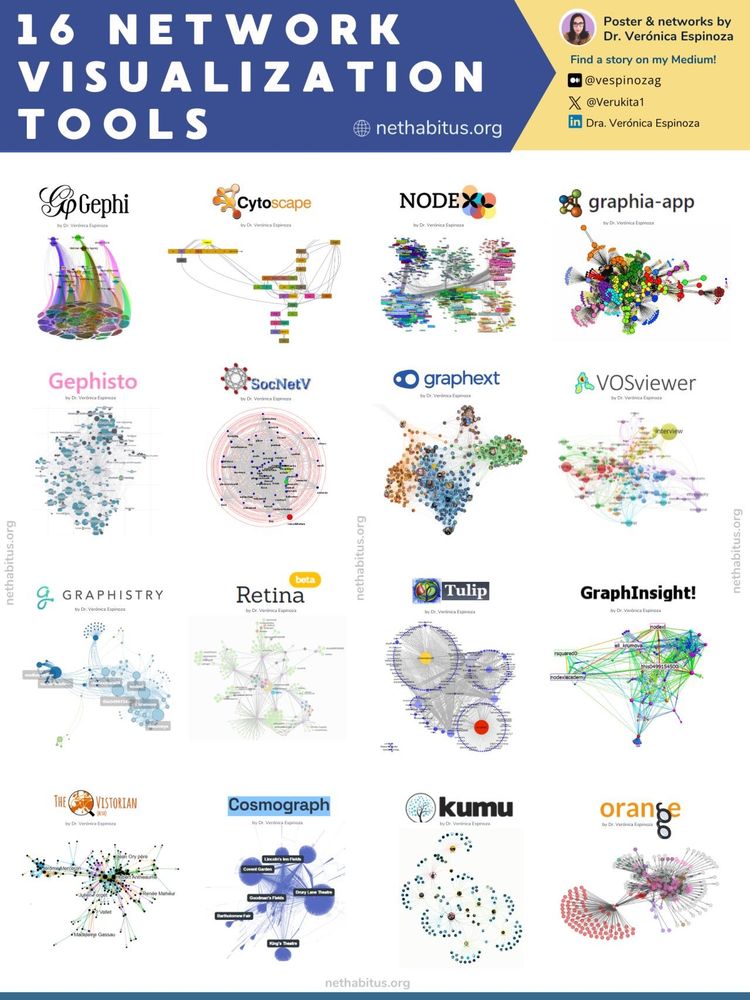
🥰16 Network visualization tools. I share with you my poster and an article I wrote on Medium.
👉Read my article: medium.com/@vespinozag/...
#NetworkScience #digitalhumanities #DataVisualization #postdoc #MachineLearning #DataScience #Bioinformatics #PhD #Python #Statistics #ai #digital #academic
📢 DH2026 review results are out!
Long papers: 164/264 (61%)
Short papers: 275/387 (71%)
Posters: 101/131 (76%)
Workshops: 18/19 (95%)
Mini-conferences: 12/13 (92%)
Check your email or ConfTool for your decision.
See you in Daejeon 🇰🇷 July 27–31!
#DH2026 #ADHO
Happy 191st birthday to the Kalavala, national epic of Finland, compiled into a single more or less coherent narrative from a vast range of traditional or oral folktales, myths and songs by scholar Elias Lönnrot and first published #onthisday in 1835.
When D3 was released in February 2011, it transformed how we build data visualizations for the web and ushered in a new age of unbridled creativity in information design, data journalism, and beyond. Today, it remains the backbone of modern, interactive data viz.
Happy 15th birthday, D3 🎂
d3js.org

Titelseite der Publikation "Das Buch ohne Nahmen : Wers nicht kauffen will, mags bleiben lassen" aus dem Jahr 1720.
Spiegel-Bestseller im Jahr 1720: "Das Buch ohne Nahmen : Wers nicht kauffen will, mags bleiben lassen"

An Episode in the Life of a Landscape Painter by César Aira
First César Aira

Group of people in a stage, holding roses.

Präsentationsfolien mit dem Text „Mind the gap! - Wissen, Unsicherheit und Verantwortung
Thank you so much for the #DHd2026 in Vienna.
A big applause again for the organising committee and all the work they put into this week.
See you in Marburg next year for the #DHd2027. Already looking forward!
Have a pleasant journey back home!
#digitalhumanities #vienna #marburg #DHd2026
This week, part of our team attended #DHd2026 in sunny Vienna — it was a joy to meet the community, exchange ideas, and present some of our current work 👇 (1/4)
In light of Lisa Teichmann's talk at #DHd2026 (doi.org/10.5281/zeno...), consider following the @gndgender.bsky.social bot by @viktor.im...
No.

Abstract: Der vorliegende Beitrag stellt einen hybriden Analyseansatz vor, der word-embedding-gestützte Topic-Modeling-Verfahren mit Distinktivitätsmaßen kombiniert, um Textgruppen zu vergleichen. Wir haben ein Topic-Modell für eine Sammlung von 600 französischen Romanen trainiert, distinktive Topics für jedes Subgenre ermittelt und diese Topics dann mit manuell erstellten textuellen Gattungsprofilen verglichen, um die Leistung verschiedener Distinktivitätsmaße bei der Identifizierung von distinktiven Topics zu evaluieren.
Macht es nicht wie ich, verpasst nicht unseren Vortrag zu BERTopics und Keyness!
Heute in der Session "Automatisierung und KI" ab 9:00 (aber unseren Vortrag erwischt ihr auch noch, wenn ihr um 10 Uhr kommt!) im Hörsaal 5.
@cnDuKeli und Julia Röttgermann […]
[Original post on fedihum.org]
errm, educated guess: dracor.org/id/ger000717 🙃
full text of this short monodrama:
dracor.org/id/ger000717...

Apparently, 750 co-presence networks from the German Drama Corpus get you the 1st place at the #DHd2026 poster award! Congrats to the @dracor.org team! 🎉
The winning poster in hi-res: doi.org/10.6084/m9.f...
A small riddle: try to find the network with just one node there!
F.A.Z. statt FAZ schreiben? Naja, wer die Zeit hat ...

A photo from one end of the Festsaal of the Wiener Rathaus, with buffet tables, a ballroom floor, and conference participants enjoying themselves
I’m starting to accept that maybe this conference has been going well. #dhd2026

Fest-Saal der Stadt Wien
Kann man machen #dhd2026

Foto des Posterbeitrags »Glaube, Liebe, Zukunftsangst – und Zimtkuchen. Ergebnisse einer szenenbasierten Analyse weiblicher Dialoge in GerDraCor mit dem Bechdel-Wallace-Test«
Noch ein #DraCor Poster auf der #DHd2026, von Sören Barkey (@unipotsdam.bsky.social).
tl;dr:
»Somit bestehen rund 5% der deutschsprachigen Dramen in DraCor den Bechdel-Wallace-Test in der vorliegenden Operationalisierung.«
Abstract:
doi.org/10.5281/zeno...

Scalable reading of our #DHd2026 poster, demonstrated in this video by @schwindt.bsky.social: youtu.be/iTvkX7pGpSM
Everything is vector graphics, zoom freely without losing a single pixel of detail.
Full-res version linked in the prior post.

Festsaal mit Plakataufstellern, Menschen sehen sich die Poster an
Herr we go, round one of the poster session this afternoon, more to come soon. Thanks everyone!
#DHd2026 #digitalhumanities #vienna #digitalegeisteswissenschaft #wien

Low-resolution preview version of our conference poster showing 750 network graphs extracted from the German Drama Corpus.
Here's our #DHd2026 poster: 750 co-presence networks from the German Drama Corpus, in chronological order. Extracted via rdracor, assembled by our art director @schwindt.bsky.social.
Full res:
doi.org/10.6084/m9.f...
Abstract:
doi.org/10.5281/zeno...
#DraCor @dracor.org #DigitalHumanities

Team Potsdam enjoying the #DHd2026 reception in Uni Wien's stunning Großer Festsaal 🥂 Great conference, great people!
Heute gibt es einen Vortrag, an dem Frederik Arnold und Robert Jäschke beteiligt sind. Um 10 Uhr in Hörsaal 2 präsentiert Philip Kraut "Schlüsselstellen der Literatur: Zur Messung literaturwissenschaftlicher Interpretationsintensität" doi.org/10.5281/zeno...
#DHd2026 #IBIgoesDHd #CLS

